By Faith Chatham - July 7, 2007
DFW REGIONAL CONCERNED CITIZENS publishes several related sites. In addition to our main page where readers can sign up to receive action alerts, we also publish several other sites.
ABOUT AIR AND WATER focuses on the environment. We post articles about gas drilling, pipelines, and water contamination, air quality, TXU buyout and other environmental issues. In the sidebar, we have links to sources for solar street lights, real time air quality readings including Current Ozone
Levels for the DFW Region, Hourly Air Pollutant and Water Pollutant Data, Airborne Particles (Smoke, soot, dust), Air Pollulant Watch List, and Air Quality Alert Data. There are links to websites of environmental groups where readers can get involved, Environmental Advocacy Groups in the NCTCOG region, and Water Conservation Districts Websites, If you know of websites which should be listed, please send the link to us at dfwrcc@gmail.com.
Most of the information on About Air and Water is activist-oriented. However we do post stories about events and entertainment including an article on the UTA Planetarium and links to games. We include links to interesting environmental sites. Resource links range from suppliers who allow you to rent solar panels to household tips for living green.
Articles are archived monthly. Visitors can read and print archived artices and search for them by keyword (or label/tags)
TEXAS RAIL is one of our newer blogs. We post content about rail relocation, schedules for the Fort Worth T, Trinity Rail Express, DART and links to Amtrak, schedules of meetings pertaining to rail services in Texas. We concentrate on the 16 County NCTCOG region but post content about rail in all areas of the state of Texas.
This site contains activist information but also contains lots of entertainment links of interest to rail enthusiasts. Content on the site is archived monthly. Archived posts can be read and printed. The site can be searched to topic, tag/label.
Our newest site is People Profit Power - Healthcare & Insurance or PPPHI. This site focuses on healthcare and insurance. In the sidebar we post links to social service resources in the NCTCOG region, helpful insurance informational links and other resources. On this site we focus on access to healthcare, insurance and governmental policy.
NEW TEXAS LAWS is an informational site. Many of the activists in the DFWRCC network have followed numerous bills through the 80th Texas Legislature. NEW TEXAS LAWS is a site where we can check on the language of a bill once it has been signed into law or became law without the governor's signature.
Grassroots News U Can Use is our oldest site. However, we only began listing it on search engines last month. For about a year it was used to post articles on the Trans Texas Corridor and candidates campaign diaries. Usually these posts were linked to articles in other blogs. Last month we began using Grassroots as a companion site to DFW REGIONAL CONCERNED CITIZENS. Content on DFWRCC focuses mainly on ethics and highway transportation. Grassroots News U Can Use contains content which amplifies transportation/ethics in government activism.
The Arlington Texan is a hometown portal for several of the founders of DFW RCC. It is an entertainment portal which allows us to post information to assist citizens of Arlington, Texas in learning of meetings and resources and information for participating in the environmental/ governmental process in Arlington. The media market is very fragmented in the DFW Metroplex. No one newspaper or television station reaches a majority of the citizens of Arlington. The "shelf life" of television broadcasts and newspaper stories is very short. The Arlington Texan is our attempt to keep some important content available longer to the citizens of Arlington. In the near future we will be adding new columnists on this site.
HUMAN IN TEXAS is DFW RCC co-founder Steve Blair's site. Steve is an environmentalist and policy analyst who has written on environmental and governmental issues for many years. Steve has collaborated on much of the research which has been posted on various sites by Faith Chatham during the past 2 years. He is one of several people who function as a "think tank" within the DFW RCC community.

Saturday, July 7, 2007
Friday, July 6, 2007
Confidentiality Interests Prevent DOT From Handing Over Docs
By Laura McGann - July 5, 2007
The Department of Transportation is citing "confidentiality interests of the Executive Branch" as the reason for hanging on to at least 53 documents the House Committee on Oversight and Government Reform wants to see.
The committee requested the documents for its investigation into whether DOT improperly lobbied Congress on behalf of the auto industry. DOT maintains that anti-lobbying measures do not apply in the alleged scheme because members of the agency contacted Congress directly. The measures only applies when an agency enlists citizens to lobby officials, lawyers for DOT argue.
Rep. Henry Waxman (D-CA) still wants a full look at the case. The situation emerged from California's request for an Environmental Protection Agency waiver that would allow it to heighten emissions standards in the state. When the deadline for EPA to make a decision neared, DOT employees contacted members of Congress about how the decision could affect the auto industry in their districts.
See Tpmuckraker
DOT Defends Lobbying Congress For Auto Industry
By Laura McGann - June 14, 2007
The Department of Transportation said in a letter earlier this week that anti-lobbying measures do not apply to its officers who contact members of Congress on behalf of the auto industry.
DOT announced this stance in a letter from the agency’s acting general counsel responding to the head of the House Committee on Oversight and Government’s request for information. The committee wants to hear more about an alleged plan to pressure members of Congress into persuading the Environmental Protection Agency to deny California a waiver allowing it to raise carbon emission standards.
DOT’s head lawyer Rosalind Knapp argued in her response that anti-lobbying law only applies when agencies call on private citizens to lobby Congress on their behalf. She also said that she advised several officials that it would not violate anti-lobbying provisions if they contacted members of Congress directly:
Despite the historical standard, Brian said she still thinks DOT’s argument is worth challenging. “I think its important not to just accept the executive branch’s opinion on what is acceptable,” Danielle said. “Congressional lawyers need to look at that law as well.”
Waxman is still pursuing the issue. He responded to the letter from DOT’s general counsel Knapp saying that there is a "need for a thorough examination of the facts”
The Department of Transportation is citing "confidentiality interests of the Executive Branch" as the reason for hanging on to at least 53 documents the House Committee on Oversight and Government Reform wants to see.
The committee requested the documents for its investigation into whether DOT improperly lobbied Congress on behalf of the auto industry. DOT maintains that anti-lobbying measures do not apply in the alleged scheme because members of the agency contacted Congress directly. The measures only applies when an agency enlists citizens to lobby officials, lawyers for DOT argue.
Rep. Henry Waxman (D-CA) still wants a full look at the case. The situation emerged from California's request for an Environmental Protection Agency waiver that would allow it to heighten emissions standards in the state. When the deadline for EPA to make a decision neared, DOT employees contacted members of Congress about how the decision could affect the auto industry in their districts.
See Tpmuckraker
DOT Defends Lobbying Congress For Auto Industry
By Laura McGann - June 14, 2007
The Department of Transportation said in a letter earlier this week that anti-lobbying measures do not apply to its officers who contact members of Congress on behalf of the auto industry.
DOT announced this stance in a letter from the agency’s acting general counsel responding to the head of the House Committee on Oversight and Government’s request for information. The committee wants to hear more about an alleged plan to pressure members of Congress into persuading the Environmental Protection Agency to deny California a waiver allowing it to raise carbon emission standards.
DOT’s head lawyer Rosalind Knapp argued in her response that anti-lobbying law only applies when agencies call on private citizens to lobby Congress on their behalf. She also said that she advised several officials that it would not violate anti-lobbying provisions if they contacted members of Congress directly:
DOTs actions in no way violated anti-lobbying restrictions, as those provisions apply to and prohibit “grass roots” lobbying intended to encourage third parties, members of special interest groups, or the general public to contact members of Congreess or State legislatures in support of or opposition to a legistlative matter.
The executive director of The Project on Government Oversight Danielle Brian said the “grass roots” language comes from a case under the Reagan administration where the Pentagon and Lockheed Martin were accused of illegally lobbying Congress. The case made it illegal for agencies to get community members involved in lobbying, but allowed agencies to contact members of Congress directly.
Despite the historical standard, Brian said she still thinks DOT’s argument is worth challenging. “I think its important not to just accept the executive branch’s opinion on what is acceptable,” Danielle said. “Congressional lawyers need to look at that law as well.”
Waxman is still pursuing the issue. He responded to the letter from DOT’s general counsel Knapp saying that there is a "need for a thorough examination of the facts”
NOTE by Faith Chatham: The letter touches on a similar issue to that raised in Texas when US DOT stated that proposed legislation would violate Federal policy and probably cause loss of transportation funding.


Your Tax Dollars at Work - TxDOTs Letting Schedule for 2007 and final project costs
By Faith Chatham - July 6, 2007
TxDOT announces the letting schedule for highway contracts on their website.
The final costs are posted on completed jobs.
Several projects ran overbudget. However, a number of projects (mainly landscaping, signage, and pavement markings projects) ran underbudget.
Here are some of the projects. (To see the full list, see the TxDOT website.
COMPLETED PROJECTS:
LET DATE: Jan 2007
HIGHWAY: SP 482 - LET STATUS: Actual
GUIDE SIGN REFURBISING
FROM SH 183 to LP 12 - 1.8 miles
ESTIMATE: $37,111
ACTUAL: $32,886
Underbudget: $4,225
LET DATE: Jan 2007
HIGHWAY: SP 348 - LET STATUS: Actual
GUIDE SIGN REFURBISHING
FROM SH 114 to IH 35E - 3.1 miles
ESTIMATE: $32,679
ACTUAL: $30,384
Underbudget: $2,334
LET DATE: Jan 2007
HIGHWAY: LP 12 - LET STATUS: Actual
GUIDE SIGN REFURBISHING
FROM DUNCANVILLE ROAD TO IH 35E - 11.5 miles
ESTIMATE: $345,646
ACTUAL: $345,247
Underbudget: $399
LET DATE: Sept 2007
HIGHWAY: VA - LET STATUS - Actual
PAVEMENT MARKINGS VARIOUS ROADWAYS - ON SYSTEM IN NE DALLAS COUNTY TO ROCKWALL CO -NEAO - 86.1 miles
ESTIMATE: $3,326,534
ACTUAL: $1,868,636
Underbudget: $1,45l7,898
LET DATE: Sept 2007
HIGHWAY: VA - LET STATUS - Actual
PAVEMENT MARKINGS VARIOUS ROADWAYS - ON SYSTEM IN KAUFMAN COUNTY - 218.1 miles
ESTIMATE: $1,175,586
ACTUAL: $ 941,022
Underbudget: $823,436
LET DATE: Sept 2007
HIGHWAY: VA - LET STATUS - Actual
PAVEMENT MARKINGS VARIOUS ROADWAYS - ON SYSTEM IN ELLIS COUNTY - 99.9 Miles
ESTIMATE: $1,511,160
ACTUAL: $ 862,483
Underbudget: $648,677
LET DATE: Sept 2007
HIGHWAY: VA - LET STATUS - Actual
PAVEMENT MARKINGS VARIOUS ROADWAYS - ON SYSTEM IN CENTRAL DALLAS COUNTY - CDAO - 0.0 miles
ESTIMATE: $12,607
ACTUAL: $ 7,239
Underbudget: $5,368
LET DATE: Sept 2007
HIGHWAY: VA - LET STATUS - Actual
PAVEMENT MARKINGS VARIOUS ROADWAYS - ON SYSTEM IN SOUTHEAST DALLAS COUNTY - SEAO - 54.8 miles
ESTIMATE: $3,155,204
ACTUAL: $2,059,099
Underbudget: $1,096,105
LET DATE: Sept 2007
HIGHWAY: VA - LET STATUS - Actual
PAVEMENT MARKINGS VARIOUS ROADWAYS - ON SYSTEM IN SOUTHWEST DALLAS COUNTY - SWAO - 6.8 miles
ESTIMATE: $296,837
ACTUAL: $255,888
Underbudget: $40,949
LET DATE: Sept 2007
HIGHWAY: VA - LET STATUS - Actual
PAVEMENT MARKINGS VARIOUS ROADWAYS - ON SYSTEM IN NORTHWEST DALLAS COUNTY - NWAO - 0.0 miles
ESTIMATE: $7,327
ACTUAL: $4,319
Underbudget: $3.008
HIGHWAY: CS WIDEN 2 LANE FACILITY TO 4 LANE FACILITY ON SAMUEL BOULEVARD FROM IH 30 TO BUCKNER BLVD (NEAR CITY OF MESQUITE) - 2.5 miles
ESTIMATE: $20,155,730
ACTUAL: $17,789,497
Underbudget: $2,366,233
LET DATE: OCT 2006
HIGHWAY: SP 366 - Let Status: Actual
CONSTRUCT NEW 6 LANE BRIDGE OVER TRINITY RIVER AT TRINITY RIVER, WEST RIVER LEVEE, TO EAST TRINITY RIVER LEVEE - .04 miles
ESTIMATE: $64,004,883
ACTUAL: $69,674,804
COST OVERRUN: $5,669,921
LET DATE: OCT 2006
HIGHWAY: CS
WIDENING EXISTING FACILITY FROM 2 LANES TO 4 LANES DIVIDED
ON MOUNTAIN CRK PKWY FROM GRADY TO NIBLO RD EXIT TO SP 408 - 3.9 miles
ESTIMATE: $36,154,810
ACTUAL: $28,644,528
Underbudget: $7,510,282
LET DATE: Dec. 2006 - LET STATUS - Actual
HIGHWAY: VA ALTERNATIVE FUELS< CHG CONVERSION DALLAS LOVE FIELD 50 SHARED RIDE SHUTTLES AND 50 SHUTTLE BUSES 0.0 miles
ESTIMATE: $875,000
ACTUAL: $875,000
ON BUDGET
LET DATE: June 2007 - LET STATUS - Actual
REHABILITATE TRINITY RIVER BRIDGE (PHASE III)
IN DALLAS ON CORINTH STREET FROM 8TH STREET TO INDUSTRIAL BLVD - 0.6 Miles
ETIMATE: $2,511,921
ACTUAL: $1,865,330
Underbudget: $646,591
LET DATE: Nov 2006 - LET STATUS - Actual
HIGHWAY: CS DART LRT OVERPASS FROM SANTE FE TRAIL OVERPASS - HILL ST TO COMMERCE ON ABANDONED SANTA FE RR 0.0 miles
ESTIMATE: $1,000,000
ACTUAL: $ 329,712
Underbudget: $670,288
Of particular note in the Fort Worth District:
LET DATE: Jan 2007 LET STATUS: Actual
HIGHWAY: IH 30
TERMINATION OF HOV/MANAGED LANE AND TRANSITION MAIN LANES FROM BALLPARK WAY TO DALLAS COUNTY LINE - 3.6 miles
ESTIMATE $4,369,393
ACTUAL: $3,152,951
and in the Dallas District:
LET DATE: Jan 2007 LET STATUS: Actual
HIGHWAY: IH 30
CONSTRUCT MANAGED LANES FROM TARRANT COUNTY LINE TO EAST OF SYLVANA AVENUE - 13.0 Miles
ESTIMATE $3,982,127
ACTUAL: $3,095,784
IH 30 HOV MANAGED LANES TARRANT AND DALLAS COUNTIES:
UNDERBUDGET $2,102,785
UPCOMING:
LET DATE: July 2007 (FY 2007) contracts for the Dallas Region include:
HIGHWAY: SP 366 - Let Status: Approved
INSTALL SENSOR STATIONS WITH COMPRESSED CCT CAMERAS from IH 35E to US 75 (1.5 miles
Estimate: $964,178
LET DATE: July 2007
HIGHWAY - LP 12 - LET STATUS: Approved
REHABILITATION OF EXISTING ROADWAY
FROM PEMBERTON HILL ROAD TO US 175 - 2.0 miles
ESTIMATE: $2,893,706
LET DATE: Aug 2007
HIGHWAY: LP 12 - LET STATUS: Approved
INSTALL FREEWAY MANAGEMENT SYSTEM ON NAFTA INCIDENT BYPASS
FROM SPUR 408 TO SH 183 - 7.9 miles
ESTIMATE: $5,032,000
LET DATE: Aug 2007
HIGHWAY: SP 408 - LET STATUS: Approved
INSTALL EQUIPMENT IN THE ITS COMMUNICATION BUILDING
From IH 20 to LOOP 12 - 4.3 miles
ESTIMATE: $120,972
LET DATE: AUG. 2007
HIGHWAY: SH 121 - LET STATUS - Approved
CONSTRUCTION OF GRADE SEPARATIONS AT FREEPORT AND SANDY LAKE
FROM TARRANT COUNTY LINE TO DENTON CREEK - 1.7 miles
ESTIMATE: $26,306,924
LET DATE: Aug 2007
HIGHWAY: VA - LET STATUS - Approved
CONSTRUCTION OF LANCASTER VISITOR'S CENTER IN THE DOWNTOWN CITY OF LANCASTER - 0.0 Miles
ESTIMATE: $1,695,000
Wednesday, July 4, 2007
TxDOT commissions border-wide bridge traffic study
The Brownsville Hearald - July 1, 2007
McALLEN — The Texas Department of Transportation is doing a yearlong study on how to make crossing into the United States from Mexico easier.
TxDOT is working with Austin-based planning, design and public involvement firm RJ Rivera Associates Inc. to conduct the Border Crossing Travel Time Study. Firm staff will look at road conditions and traffic and pedestrian counts up to two miles from 26 Texas-Mexico border crossings.
The study began in January and ends early next year. Some preliminary meetings have already taken place in Pharr with city and county government and transportation leaders, the Texas Department of Public Safety and others.
The study does not encompass traffic waiting on bridges or at security checkpoints, said Rafael Cruz Rodriguez, the firm’s project manager.
The study’s purpose is to determine what projects can be developed in five years or less to improve traffic and pedestrian flow.
Bettering border crossings would help with the flow of goods and services, said Keith Patridge, president and chief executive officer of the McAllen Economic Development Corp. He said improvements like streamlining state and federal vehicle checks should not hurt homeland security.
“It’s not a paperwork issue,” Patridge said. “It’s actually the physical constraints that come in by the capacity of the bridge roads, the movement of getting trucks off the bridge to (Expressway 83) and ultimately to (U.S. Highway) 281 north. All of those are the issues that create more of an issue than the actual time on the bridge.”
The firm also has set up a hotline to gather public input.
“It’s just basically to accommodate concerned citizens, to let us know what they feel the issues are or what experiences have they had while they are going through the TxDOT network once they cross the border crossing,” Rodriguez said.
Emma Garcia of San Juan has her ideas for making the crossing process better. She occasionally uses the Hidalgo-Reynosa International Bridge to trek to Reynosa to shop and said both sides of the bridge need litter to be picked up and more security and lighting.
She said it has taken her up to two hours to leave the bridge and security area and wait in traffic on International Boulevard in Hidalgo, which becomes South 23rd Street once in the McAllen city limits.
“Sometimes you have to turn off the air conditioning because the car starts to turn off,” said Garcia, a unit director at the Pharr Boys & Girls Club.
MAKE YOUR COMMENTS KNOWN
RJ Rivera Associates Inc. has set up a toll-free hotline people can call in English and Spanish to give comments on their bridge crossing experiences. The phone number is (877) 800-6680.
ON THE WEB RJ Rivera TxDOT
www.rjrivera.com
www.dot.state.tx.us
See Brownsville Herald
TAXES AND GAS WELLS
TAXES AND GAS WELLS
Recently, it has come to be known that people who own property and mineral rights in Tarrant County may see a sharp increase in their Tarrant County Property Assessment Taxes. The Tarrant County Appraisal District is assessing new figures based upon the potential royalty earnings from Gas Well Drillings. Since lateral drilling allows lines to go one mile in any direction from the actual well site, literally every property/mineral rights owner in Tarrant may well be impacted.
Compound this with the Federal Income or Capital Gains Tax upon any royalties paid, and the royalty payments being promised by the drilling companies begins to significant pale.
Then add the Federal Windfall Tax, and royalty payments become negligible, or even negative.
But please note that none of these taxes are capped for anyone over the age of 65, and suddenly, many people on fixed incomes will be receiving the largest tax increase ever for them.
Is it not interesting that all of this was done without any information being made available to the public?
Monday, July 2, 2007
NTTA Anticipated Credit Watch Decision by Rating Agencies
NTTA - July 2, 2007
Plano, TX – On June 28, 2007, the Texas Transportation Commission selected the NTTA to develop and operate State Highway (SH) 121. NTTA expects to finance SH 121 through its Dallas North Tollway (DNT) System. The NTTA proposal for SH 121 committed an upfront payment to the State of $2.5 billion, $833 million marketable security or to be included in the upfront payment to the State, and estimated construction costs of approximately $700 million. Various interim financing tools are expected to be used for initial financing of the upfront payment and the construction costs. The take-out financing is planned to be accomplished through the issuance of long term debt under the NTTA's DNT System.
“We have a strong DNT System, a strong project, a strong team and a strong finance plan for the SH 121 toll project in Collin, Dallas and Denton counties in north Texas,” said Susan Buse, CFO, NTTA. “This is a great opportunity for the NTTA and a real plus for our customers and the citizens of north Texas. As we negotiate the project agreement with regional transportation leaders and the State, we will be finalizing our finance plan in full communication with the rating agencies, our bond insurers and the market.”
The DNT System’s long term debt is currently rated A1, A+ and A+ by Moody's Investors Service, Standard & Poor’s and Fitch Ratings, respectively. As previously acknowledged, ratings are expected to decline slightly for NTTA in connection with SH 121 financing and the lower ratings were reflected in the finance plan. This expectation is supported by the notifications from rating agencies that the NTTA's bonds have been placed on credit watch with negative indications.
“For the last two years, our Board of Directors has encouraged us to more efficiently leverage the System. The senior lien bond ratings are expected to remain in the “A” category from the rating agencies,” added Buse.
RBC Capital Markets is the NTTA's financial advisor, McCall, Parkhurst & Horton LLP is bond counsel and Bear Stearns & Co., Citigroup and Lehman Brothers are the senior managing underwriters for the SH 121 project financing.
About NTTA
The North Texas Tollway Authority, a political subdivision of the State of Texas, is authorized to acquire, construct, maintain, repair and operate turnpike projects in the North Texas region. The seven-member governing board is comprised of Chairman Paul N. Wageman, Vice Chairman Jack Miller, Directors Gary Base, David Denison, William W. Meadows, Bob Shepard and Alan Sims.
The NTTA serves Collin, Dallas, Denton and Tarrant Counties and is responsible for the Dallas North Tollway System, consisting of the Dallas North Tollway, President George Bush Turnpike, Addison Airport Toll Tunnel, Lewisville Lake Toll Bridge and the Mountain Creek Lake Bridge. The North Texas Tollway Authority is able to raise capital for construction projects through the issuance of turnpike revenue bonds. NTTA toll projects are not a part of the State highway system and receive no direct tax funding. Tolls are collected to repay debt and to operate and maintain the roadways.
Visit the NTTA Web site at or call 214-461-2000 for additional information about the North Texas Tollway Authority. For Customer Service, please call 972-818-NTTA (6882).
Political Toll - Moratorium preserves big chunks of Perry's Trans-Texas Corridor
by Eileen Welsome - The Texas Observer - June 15, 2007
The conservatively dressed representatives of the Texas Department of Transportation who walked into the Capitol rotunda this spring found themselves engulfed in a perfect storm. For months, bloggers had been at their keyboards, whipping up fractious constituents. Demonstrations had been held, bumper stickers passed out, and alliances forged between groups that normally find themselves at opposing ends of the political spectrum. They had a common goal: slaying the Hydra-headed monster—the Trans-Texas Corridor—a network of supercorridors with lanes for cars, trucks, trains, and pipelines, as well as other infrastructure.
Ric Williamson, who chaired the monthly Texas Transportation Commission meetings with the benign indifference of Henry the Eighth, could have looked out a window of the gothic Greer Building on 11th Street and seen the gathering clouds at the Capitol. But Williamson, an old friend of Gov. Rick Perry and an ex-legislator himself, was not concerned with such piffle. He had more important things on his mind, like the $86 billion shortfall that TxDOT faced in a few decades, when there would not be enough money to maintain roads. Williamson felt the best way to solve the $86 billion problem (a figure state auditors would later say was inflated) was to let deep-pocketed multinational companies build gleaming new tollways that would be paid for by Texas drivers for the next two, three, or even four generations.
Read entire article in The Texas Observer
Read earlier article:
Low-Hanging Fruit
Texas faces obvious problems that the 80th Lege should fix. It probably won't.
by David Pasztor - The Texas Observer - Jan. 26, 2007
Streets of Gold
See entire article
The conservatively dressed representatives of the Texas Department of Transportation who walked into the Capitol rotunda this spring found themselves engulfed in a perfect storm. For months, bloggers had been at their keyboards, whipping up fractious constituents. Demonstrations had been held, bumper stickers passed out, and alliances forged between groups that normally find themselves at opposing ends of the political spectrum. They had a common goal: slaying the Hydra-headed monster—the Trans-Texas Corridor—a network of supercorridors with lanes for cars, trucks, trains, and pipelines, as well as other infrastructure.
Ric Williamson, who chaired the monthly Texas Transportation Commission meetings with the benign indifference of Henry the Eighth, could have looked out a window of the gothic Greer Building on 11th Street and seen the gathering clouds at the Capitol. But Williamson, an old friend of Gov. Rick Perry and an ex-legislator himself, was not concerned with such piffle. He had more important things on his mind, like the $86 billion shortfall that TxDOT faced in a few decades, when there would not be enough money to maintain roads. Williamson felt the best way to solve the $86 billion problem (a figure state auditors would later say was inflated) was to let deep-pocketed multinational companies build gleaming new tollways that would be paid for by Texas drivers for the next two, three, or even four generations.
Read entire article in The Texas Observer
Read earlier article:
Low-Hanging Fruit
Texas faces obvious problems that the 80th Lege should fix. It probably won't.
by David Pasztor - The Texas Observer - Jan. 26, 2007
Streets of Gold
Since 2001, a clique of powerful Texas officials and their friends in the business community have been laying the legal and legislative groundwork to build a network of superhighways and toll roads. One of the most ambitious road-building plans in the world, the for-pay highways will suck up thousands of acres of farmland, induce development, and do little to reduce congestion along the state’s most glutted highways, most notably Interstate 35.
In the process, thousands of miles of state roads that have already been paid for by motorists through gasoline taxes will be turned over to multinational firms that will collect tolls for the next 50 years or so. The deals have drawn plenty of criticism, but with the help of state legislators and a fleet of Madison Avenue-styled public relations firms, highway officials so far have succeeded in steamrolling the opposition. The current leadership authored the plan and has shown little willingness to back away.
New highway proposals are on the drawing board, and portions of State Highway 130, which will likely be the first leg of what’s called the Trans-Texas Corridor 35, are already open. Perry, Round Rock’s Republican state Rep. Mike Krusee, and Ric Williamson, chairman of the Texas Transportation Commission, are the three officials primarily responsible for pushing this new world order.
In the coming weeks, the Texas Department of Transportation—an agency with annual revenues greater than the entire income of some states—will be back at the Legislature trying to widen its powers. It will also be asking for millions to fund a new entity called the Texas Rail Relocation and Improvement Fund, which basically will help two of the largest rail carriers in Texas—Burlington Northern Santa Fe Corp. and Union Pacific Corp.—upgrade their rail lines and cash in on the staggering growth in freight transportation projected for the next 10 years or so.
TXDOT wants to lift the cap on the 50- to 70-year contracts so it can negotiate more contracts lasting for as long as 100 years with multinationals from Spain, Australia, and Sweden. TXDOT also wants to amend state laws so it can perform its own environmental reviews and approvals. It might seem like an obvious conflict of interest for a department whose main function is to bulldoze and pave, but TXDOT says it could use the latitude to build projects faster, thereby reducing congestion, improving air quality, and enhancing safety.
Though deals are being drawn up, contracts signed, and concrete poured, there’s still time to rethink the toll roads if legislators decide to enact a moratorium and demand an open and honest debate with the public about how to address transportation gridlock. Then voters could be allowed to decide by what road they prefer to travel. That, as the poet says, may make all the difference.
The Best Leadership Money Can Buy
A good argument can be made that Texas’ inability to deal with its pressing problems stems from the ironclad grip a few contributors and lobbyists hold over the state’s policy agenda. The influence of their money drives the privatization debate and is felt in most every policy area, from education to transportation and electricity to social services. In one small example, most Texans, including most legislators, are opposed to school vouchers. The fear is that they will take money away from already underfunded public schools. Yet in 2005, Speaker Craddick scheduled a vote on a voucher bill. Might this have had something to do with the fact that the state’s biggest voucher proponent, hospital-bed magnate James Leininger, is also one of the GOP’s biggest political donors? Most recently, in the 2005-2006 election cycle, Leininger gave more than $5 million to Texas candidates. He’s not the only one. Republican home builder Bob Perry—the biggest political donor in the state and nation—gave $6.7 million to Texas candidates and political action committees, according to campaign watchdog Texans for Public Justice.
A number of simple steps could instantly diminish the power of money over sound public policy in Texas. The first would be an aggregate limit on individual contributions. Texas is one of the few states that have no limits on the size of campaign contributions, allowing mega-donors like Perry and Leininger to swamp an election with an endless flow of cash. During the 2004 election cycle, 87 individuals or couples donated more than $100,000 each to state candidates and committees. This accounted for 10 percent of all political donations. TPJ is part of a campaign-reform coalition that has suggested a modest contribution cap of $100,000 per election cycle. While legislation has been filed along these lines, with the current leadership it’s not likely to prosper.
In June 2006, state District Judge Mike Lynch tossed out a felony indictment against the Texas Association of Business. Lynch ruled that TAB had not expressly advocated the election or defeat of candidates when it spent $1.9 million in secret corporate money on “issue” ads in the 2002 election cycle. Lynch wrote in his order that most “non-technical, common-sense people” would see the ads as clearly violating the law, but that “these statutes and this indictment aren’t equipped to do the job [of keeping corporate money out of elections].” Unless the law is strengthened to strictly prohibit the use of corporate money for electioneering, business interests like TAB will once again use undisclosed corporate money to smear candidates with whom they disagree.
Finally, more legislation would probably not be necessary if Texas had a functioning Ethics Commission. Unfortunately, to call the current commission dysfunctional and ineffectual is charitable. It is a paper tiger, underfunded and, worse, loathe to enforce the law or improve upon it through its rule-making authority. At a minimum, legislators should create a separate law-enforcement division for the commission. They should also provide for a budget based on a funding formula that is independent of the Legislature. Finally, the eight-member commission should be abolished and replaced with one accountable executive director. As with most of what Texas desperately needs fixed, the state’s leaders won’t likely give the keys to the henhouse back to the public this session without a fight.
See entire article
Saturday, June 30, 2007
In Texas, even losing bidders on toll road projects get paid
By GORDON DICKSON - Fort Worth Star Telegram - Mon, Jun. 25, 2007
Unsuccessful bidders have received $4.1 million since 2002 for intellectual property, Texas Department of Transportation records show. The state began making payments several years ago so that private companies would compete more vigorously for toll projects.
"It's not a consolation prize," agency spokeswoman Gabriela Garcia said. "We're not just paying for paper. We take their proposals and, even though they're an unsuccessful proposer, we use pieces of it and incorporate those ideas into the final product."
The Texas Transportation Commission could pay as much as $2.25 million to three companies that bid on the Texas 121 toll road project in Denton and Collin counties.
...
Three companies that submitted Texas 121 bids would then be eligible for up to $750,000 each -- although a final decision on the amount may take several months.
Australia-based Macquerie and Sweden-based Skanska were eliminated in February. Spain-based Cintra is still in the running for Texas 121.
A stipend won't come close to covering costs, said Jose Maria Lopez, Cintra director of U.S. projects. He estimated that the company and its adviser, JPMorgan Asset Management, spent $5 million in the past year trying to win the Texas 121 deal.
"It's 20-some people in our office working on that," Lopez said in a phone interview from New York, where he met with investors to talk about, among other things, the Texas 121 project. "If you add up the auditors, consultants, it could be well north of 100 people."
What if Cintra wins?
State transportation commissioners have said they would abide by the region's decision on Texas 121, despite worries that selecting the tollway authority could scare off private bidders for future projects.
If the state commission were to select Cintra, Macquerie and Skanska would still be eligible for stipends -- but the North Texas Tollway Authority probably would not, officials said. The tollway authority was not part of the yearlong bidding process won by Cintra in February. Instead, it was allowed to submit an 11th-hour proposal in March at the insistence of Dallas-area lawmakers who opposed a private toll project.
Whether it was fair to allow the tollway authority to enter the competition late is a key issue before the state commissioners, who on Thursday may discuss the state's vulnerability to lawsuits in the matter.
Violation of federal law
Allowing the tollway authority to bid after the process had ended violates federal rules and effectively killed any further federal money for the Texas 121 project.
It's unclear whether Texas will be asked to repay $237 million in federal funds already spent on the Lewisville-Carrollton portion of the toll road that was completed last year.
In May, the Federal Highway Administration sent a letter to the Transportation Department warning that awarding the project to the tollway authority would violate federal procurement rules, making the project ineligible for federal funds.
But the letter didn't address funds already spent. State transportation officials are trying to get a clarification from federal officials before Thursday's meeting.
Tollway authority officials say federal procurement laws aren't an issue, because they don't need federal funds to finish the road.
"It's a public roadway right now. We're a public agency. The project is never out of the public's hands," said Jerry Hiebert, tollway authority executive director.
Time to move dirt
Regional Transportation Council members will attend Thursday's meeting and request commission approval of the tollway authority's proposal, said Michael Morris, transportation director for the North Central Texas Council of Governments.
RTC members were split on the matter, with the tollway authority beating Cintra by a 27-10 vote, but they are now eager to build the remaining section of the road between Carrollton and McKinney.
"At some point," Morris said, "we've got to move on."
Losing bids
Losing bidders who have been paid for their intellectual property since 2002:
-- Texas 130, Georgetown to Austin, 49 miles: Two unsuccessful bidders were paid $1.3 million each. Winner: Lone Star Infrastructure.
-- Trans-Texas Corridor, master plan for the TTC-35 Oklahoma-to-Mexico route (including Dallas-Fort Worth), 600 miles: Two unsuccessful bidders were paid $750,000 each. Winner: Cintra Zachry.
-- Texas 121, Denton and Collin counties, 26 miles: As many as three private companies could be eligible for $750,000 each if the contract is awarded to the North Texas Tollway Authority. The tollway authority, which is a public body, likely would not be eligible for funding.
Source: Texas Department of Transportation
See full article in Fort Worth Star-Telegram
Parker County audit comes back clean
Galen Scott - Weatherford Democrat - June 27, 2007
A private auditing service reported mostly good news for Parker County Commissioners Tuesday, noting marked improvements in the county’s financial record keeping.
Kathy Williams, a partner with the Weatherford-based accounting firm Snow, Garrett and Company, confirmed the county’s expenditures and revenue figures from last fiscal year did conform to government auditing standards — considered to be among the report’s most significant findings.
The audit failed to find any material weaknesses in county government’s internal control system for the fiscal year ending in September 2006.
Material weaknesses are exposed when an auditor finds certain internal record keeping practices that allow too much risk for misstatement or fraud.
In an audit of fiscal year 2005, material adjusting entries were necessary to correct balances reported that year for the county’s pooled cash and investment accounts. Also, annual audit data was not reported on time and quarterly internal audits were not being performed.
“It’s a major improvement from previous years, that we don’t have any material weaknesses to report in this letter,” Williams said Tuesday.
However, Williams pointed out quarterly internal audits are still not being performed. The audit’s findings suggest turnover in the County Auditor’s Office are probably at the root of the problem, and a plan of corrective action was attached in the report.
“Overall, this was a much, much better year,” Williams said.
County Judge Mark Riley, chief executive of Parker County, praised the efforts of County Auditor Mike Rhoten, his staff and new County Purchasing Agent Deena Nichols for helping to turn things around.
“This is obviously the result of Mr. Rhoten and his staff,” Riley said. “He has made a lot of positive changes in that office and it shows.”
Last April, Parker County district court judges hired Rhoten, formerly a real estate broker in Willow Park, to replace outgoing County Auditor Shelley Saunders. Rhoten became the fifth auditor to serve Parker County in the last 10 years.
See Weatherford Democrat
Friday, June 29, 2007
Trinity toll road opponents force a vote
By BRUCE TOMASO - The Dallas Morning News - Friday, June 29, 2007
Supporters of a referendum in Dallas to scuttle the Trinity River toll road said Friday that they have enough signatures to force a November vote.
They turned in what they said are more than 48,000 signatures of registered Dallas voters by Friday’s deadline. If enough of those signatures are verified as valid by the city secretary’s office, a measure to remove the proposed toll road from the Trinity River corridor will go before voters in the fall.
City Council member Angela Hunt headed the effort to put the matter before Dallas voters. She and her group, TrinityVote, contend that the toll road should be scrapped because it will detract from a proposed downtown river park. They say that when Dallas voters approved $246 million in bonds for the Trinity River Corridor Project in 1998, many thought they were voting for a low-speed parkway, not a high-speed, multi-lane toll road.
See more Trinity Toll Road/ Trinity Parkway stories on WFAA
Supporters of the road say it's needed to alleviate downtown congestion, and that removing it now from the plans could delay work on other aspects of the Trinity project, including the park and flood-control improvements.
NTTA's Standard and Poor Rating A+
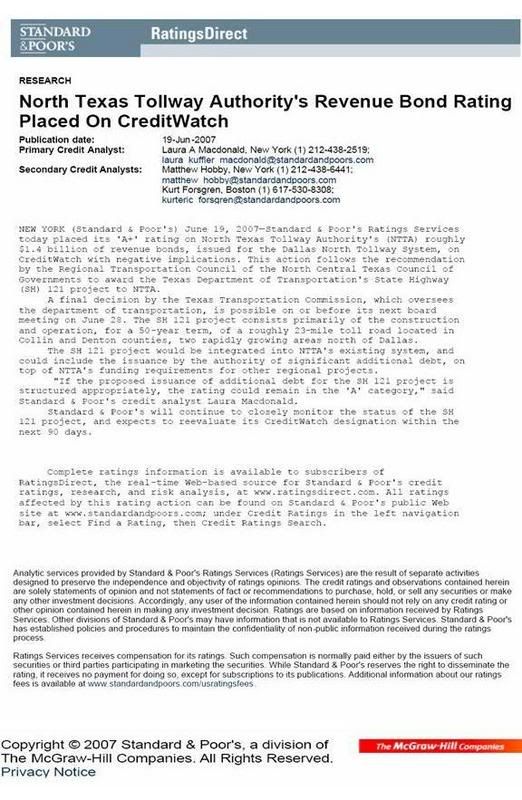
Standard and Poor reports that with announcement that NTTA will issue roughly $1.4 billion in SH 121 bonds, S&P is putting NTTA on Credit Watch. It is anticipated that NTTA's bond rating will drop from A+ to A when these bonds are issued.
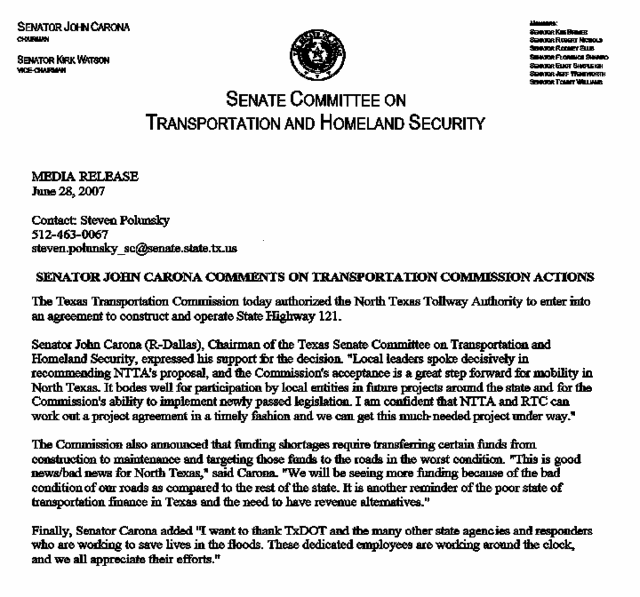
Minute Order of Texas Transportation Commission on SH 121
MINUTEORDER 6-28-2007
COLLIN AND DENTON Counties
DALLAS District
Transportation Code, §223.210(h) provides that the moratorium on certain comprehensive development agreements imposed by that section does not apply to a comprehensive development agreement entered into in connection with the SH 121 project if before the Texas Transportation Commission (commission) or the Texas Department of Transportation (department) enters into a contract for the financing, construction, or operation of the project with a private participant, an authority under Chapter 366 was granted the ability to finance, construct, or operate, as applicable, the portion of the toll project located within the boundaries of the North Texas Tollway Authority (NITA), and the authority was granted a period of 60 days from March 26, 2007, to submit a commitment to the metropolitan planning organization which is determined to be equal to or greater than any other commitment submitted prior to March 26, 2007.
Transportation Code, §223.21O(h) also provides that ifthe financial value ofthe commitment submitted by the authority is determined to be equal to or greater value than any other commitment submitted prior to March 26, 2007, the commission shall allow the NITA to develop the project.
On March 26, 2007, the Chair of the Regional Transportation Council (RTC), the metropolitan planning organization for the Dallas-Fort Worth region, sent a letter to the chairmen of the commission and the NITA that in part asked the NITA to determine if the NITA Board wished to submit a binding commitment for the SH 121 toll project. If so, the submission would be due to the RTC no later than May 25, 2007.
In the March 26, 2007 letter, the Chair of the RTC indicated that any binding commitment submitted by the NITA would need to: (1) clearly state what is "guaranteed" in its proposal; (2) specify and communicate the risk that will be borne by users of the NITA System due to (a) a change in bond rating, (b) possible toll rate increases on other NITA facilities, and (c) the delayed development of committed projects; and (3) describe any other toll projects which cannot be built by NITA in a timely fashion.
On May 18,2007, the NITA submitted a public sector proposal to finance, design, construct, operate, and maintain the SH 121 toll project to the RTC. As requested in the RTC's March 26,2007 letter, the department reviewed the NITA submission and compared that submission with the proposal submitted by Cintra Concesiones de Infraestructuras de Transporte, S.A. (Cintra) in response to the department's request for proposals. The RTC also contracted with PricewaterhouseCoopers to act as independent financial advisor to the RTC for the purpose of assessing the financial value of the Cintra proposal and the NITA submission using the criteria in Transportation Code, §223.21O(h).
On June 18,2007, the RTC passed a motion that the NITA undertake the development, design, construction, financing, operation, and maintenance of the SH 121 toll project, and requested that the commission approve the selection of the NITA for the SH 121 toll project.
The NITA submission did not include a formal commitment to execute a pre-determined project agreement, as was required under the department's request for proposals, or firm lending commitments. The NITA has indicated that their ability to achieve financial close within 60 days from the date of the NITA's selection is certain. However, under the NITA submission, commitments to finance the SH 121 toll project are conditioned on the execution of a project agreement between the department and the NITA in a form acceptable to the underwriters and lenders. Moreover, the summary of the review of the NITA submission prepared by RTC staff letter.
The NITA proposes to finance the SH 121 toll project as part ofthe NITA System, with some project costs paid from revenue derived from other parts ofthe system. The NITA system is exposed ifproject costs are higher, traffic and revenue is lower or service commencement is delayed, or the rate of inflation by which toll rates may be escalated is lower than current estimates. The negative impact ofthese risks could be borne by users in the form of higher system tolls and by local communities if previously committed projects are delayed or cannot be constructed.
IT IS THEREFORE ORDERED by the commission that the RTC recommendation that the NITA undertake the development, design, construction, financing, operation, and maintenance of the SH 121 toll project is approved.
IT IS FURTHER ORDERED that the department is authorized to enter into a project agreement with the NITA if: (I) within 60 days from the date of this order, RTC staff has negotiated withthe NITAthemajorterms oftheprojectagreement andhassubmittedthosetermstothe department, and a quantification ofpublic benefits anticipated to be derived from the NITA's development, design, construction, financing, operation, and maintenance of the SH 121 toll project has been agreed to by the RTC; and (2) the NITA is able to achieve financial close, including payment ofthe agreed upfront payment amount, concurrently with or no later than 45 days after the execution and delivery of the project agreement. In the event financial close occurs after the execution and delivery of the project agreement, the agreement shall include a provision requiring termination ofthe agreement if financial close, including payment ofthe agreed upfront payment amount, is not achieved by the end ofthe 45 days allowed under this order.
IT IS FURTHER ORDERED that the major terms to be negotiated by the RTC staff shall include: (I) the timing and amount of the annual payments; (2) adherence by the NITA with the RTC's toll rate policy; (3) enforcement provisions and remedies for the NITA's failure to comply with the toll rate policy, project schedule, payment obligations, and other commitments; and (4) the term of the agreement.
Fort Worth Star-Telegram coverage of Texas Transportation Commission SH 121 decision
Public agency gets toll road
By GORDON DICKSON - Fort Worth Star-Telegram - Thu, Jun. 28, 2007
The Texas Transportation Commission has agreed to let the North Texas Tollway Authority build the Texas 121 toll road in Denton and Collin counties, rejecting a bid from the private Spanish firm Cintra.
The Plano-based tollway authority has committed to pay the North Texas region $3.3 billion for use on other transportation projects.
Now that the state commission has decided the tollway authority's plan is the best value, the next step is for the tollway authority to negotiate a project contract with the Metroplex's Regional Transportation Council, a process expected to take a month or two. The authority would have another 45 days to close its financial arrangements.
The commission voted 4-1 Thursday afternoon to approve the plan during a meeting in Austin. The dissenter was Ted Houghton of El Paso, who wanted the negotiations to include a member of the Texas Department of Transportation. "I'm against us being on the sidelines," he said.
But commission chairman Ric Williamson of Weatherford preferred that TxDot employees take a step back and let North Texans work out the deal themselves. "Right now, RTC and NTTA are all getting along and they've all agreed as to how they want to do this." Williamson is a longtime champion of decentralizing TxDot's powers so that metro areas may decide road-building priorities on their own.
Williamson also said he would prefer that his agency's employees stand at arm's length from the process, to avoid being unfairly criticized for trying to manipulate the results. In recent months, TxDot officials have been accused of forcing the tollway authority out of the Texas 121 bidding so that private companies such as Cintra could have the project.
"I've had it with toll operators, and House and Senate members, and former commissioners accusing good state employees," he said.
In addition to paying $3.3 billion to the region, most of it up front, the tollway authority has agreed to add five new toll road projects to its existing Dallas-area toll road system within five years. Three of those five projects are in the western Metroplex: The Texas 121T (aka Southwest Parkway) extension to Cleburne, Texas 360 in Mansfield and Texas 170 in the Alliance area. Texas 161 in Grand Prairie, a reliever route for overused Texas 360 in Arlington, is also under consideration.
But still unknown is whether the commission's decision may expose the state to lawsuits from either Cintra or two other companies that originally competed for the project. Cintra originally won the bid, with a promise to pay $2.9 billion, but lawmakers intervened and demanded that the tollway authority get another chance.
The Federal Highway Administration later determined that intervention violated federal procurement rules, making Texas 121 toll road ineligible for future federal funds. The tollway authority doesn't intend to use federal funds going forward, but $236 million in federal funds has already been spent on the road and it's unclear if Texas will be asked to refund part or all of that amount.
If such a refund were necessary, it would reduce the overall amount of highway funding available for the Metroplex.
Check out the Honkin' Mad traffic blog for more details about the decision.
UPDATE 3-Texas agency again tops Cintra for road project
By Joan Gralla - Reuters - Thursday, June 28, 2007
NEW YORK, June 28 (Reuters) - Texas on Thursday conditionally approved a public agency to overhaul a busy Dallas-Fort Worth highway instead of Spanish toll-road firm Cintra (CCIT.MC: Quote, Profile, Research), a decision that analysts said could stall road privatization plans in other states.
The North Texas Tollway Authority outbid Cintra by $500 million, offering a $2.5 billion upfront payment and $833 million in annual lease payments.
Thursday's decision was made by the state transportation commission, which selected the North Texas Tollway Authority by a vote of four to one, said spokesman Mark Cross.
Cintra in February won the deal to overhaul State Highway 121, but critics said the terms overly favored the developer by including a non-compete clause and a 50-year lease.
Texas lawmakers responded by asking the local highway authority to submit a competing bid.
The legislature also enacted new curbs on such privatizations, which allow developers to lease state highways for long periods in return for the toll revenue.
New Jersey and other states weighing road privatizations have said they are closely following the twists and turns of Texas' saga because they want to avoid a similar backlash.
Cintra and the JPMorgan Fund, its partner, said in a statement on Thursday their bid was better because "contracts are in place, toll rates are capped, lending commitments are made, design work is complete and we are ready to roll up our sleeves and get to work."
The companies added their deal would invest $7.3 billion in the Dallas-Fort Worth area over the next 50 years.
Texas' Regional Transportation Council on June 19 picked the public authority instead of Cintra and state Commission Chair Ric Williamson has set a policy of deferring to local policy-makers, said his spokesman, Randall Dillard.
The regional council and the North Texas Tollway Authority now have about 60 days to draft more detailed plans, including the timing, annual payments, enforcement clauses, toll policy and the length of the pact, Dillard said.
The authority will then have about 45 days to secure the financing and sign a contract with the state commission.
"We've already authorized our staff to sign the Cintra proposal," the Commission chair noted during the meeting, broadcast on its Web site (http://www.txdot.gov).
"If they (the authority) can't get there, we'll sign the project with Cintra," he added.
Commissioner Ted Houghton dissented, stressing how inflamed the battle has been. "It's unfortunate that they (Cintra) have been vilified as foreigners," he said.
Cintra is one of the huge European companies that develops toll roads around the world. This approach is much more common in Europe, Asia and Latin American than in the United States.
The commissioners praised the private road developers for sparking the competition that produced Thursday's award.
Dillard said the State Highway 121 overhaul "was really just a long-range dream" until the private companies competed for the work. Asked if the commission would now return to using public agencies instead of developers, he replied that this project was "a good example of empowering local officials."
State Highway 121 is prized by developers because Dallas and Fort Worth are some of the fastest growing U.S. suburbs. For example, Collin County, which lies just north of Dallas, is expected to draw 514,000 new residents from 2005 to 2030.
Chicago sparked U.S. interest in this way of funding new highways without hiking taxes two years ago when it got $1.83 billion for leasing its main commuter link to Indiana, the Skyway toll bridge, to Cintra, part of Ferrovial (FER.MC: Quote, Profile, Research), and MIG, run by Australian bank Macquarie Bank Ltd. (MBL.AX: Quote, Profile, Research)
Fiscal monitors, however, have bashed Chicago's strategy, saying its 99-year pact is much too long and fails to give taxpayers the extra toll revenue the companies can get.
The North Texas Tollway Authority has said private firms may be better suited to developing roads in undeveloped areas because the bigger risk may justify their bigger profits.
Report in Reuters
Subscribe to:
Posts (Atom)


