Friday, July 27, 2007

Texas Senate Transportation & Homeland Security Hearing scheduled in Irving August 7th

SENATE NOTICE OF PUBLIC HEARING


COMMITTEE: Transportation & Homeland Security
TIME & DATE: 8:00 AM, Tuesday, August 07, 2007
PLACE: Irving Lecture Hall, Westin DFW Airport
CHAIR: Senator John Carona

The Senate Committee on Transportation and Homeland Security will meet on August 7, 2007, in Irving. The hearing will be held at the Westin DFW Airport hotel on 4545 W. John Carpenter Freeway, Irving, Texas.

The Committee will begin at 8:00 a.m. and hear invited and public testimony on the implementation of legislation and related issues.

Agenda (subject to change)

INVITED TESTIMONY: TRANSPORTATION


Panel 1: Texas Transportation Commission/Texas Department of Transportation

Panel 2: Regional Transportation Council and North Texas Turnpike Authority

Panel 3: TEX-21

Panel 4: Infrastructure Issues

A. Trends in Infrastructure (Bob Cuellar, URS Corporation)

B. Infrastructure Protection (Albert Samano, TRC Corporation)

C. Managed Lanes (Dr. Chris Poe, Texas Transportation Institute)

D. Continuing Concerns (David Stall, CorridorWatch)

INVITED TESTIMONY: HOMELAND SECURITY


Panel 1: Steve McCraw, Dir. of Homeland Security, Office of the Governor

Panel 2: Thomas Davis, Executive Director, Department of Public Safety

Panel 3: Gangs

A. Fred Burton, Stratfor

B. John Chakwin, Special Agent in Charge, Immigration and Customs Enforcement, Dallas

C. David Erinakes, Homeland Security Policy Advisor to the Chairman

PUBLIC TESTIMONY

Wednesday, July 25, 2007

IH-35 ramp to N. Dallas Tollway closed due to fire

NTTA - Wed. July 25, 2007, 11:35 a.m.Due to a fire near Downtown Dallas, the exit ramp to IH-35 from the Tollway heading southbound and the entrance ramp from IH-35 to enter the Tollway going northbound are shut down.

Motorists on the south end of the Tollway planning to enter IH-35 must seek alternate routes. Delays can be expected.

This action is being taken at the request of emergency responders.

Tuesday, July 24, 2007

Ft Worth T fares to increase in Oct.

Fort Worth T - July 19, 2007
FORT WORTH -- The board of directors of the Fort Worth Transportation Authority (The T) approved a change in fares at its board meeting on July 19. The new fares are expected to generate additional revenue of $400,000 to help offset rising operating costs and allow further expansion of T bus services to meet the growing population needs.

The first fare increase in four years, the new fares will take effect October 1.

The new fares include an increase of 25 cents per one-way trip for local, premium and Mobility Impaired Services.

Monthly passes will increase by $10. A new weekly pass will be offered at $15 for seven days of unlimited rides. It is designed especially to accommodate customers who ride frequently, but cannot afford a larger once-a-month cash outlay for a monthly pass.

Reduced fares for seniors, disabled and students will be set at one-half of the base fare, in keeping with federal requirements.

Prior to implementing the new fares, The T held four public hearings on May 29 and a special hearing for MITS customers on June 13 to gather customer comments regarding the proposed increases. Comments from public meetings, The T's hotline, website and comment cards were presented to the board as input into its decision.

Two meetings also were held for customers who use E-Passes purchased through their employers. Changes in the employer pass are scheduled to go into effect January 1, 2008.

"We understand that people would prefer that prices remain the same, but I believe most citizens understand the need for The T to keep up with rising operating costs," said Bob Jameson, chairman of The T board.

The T's fares currently cover only 12 cents of every dollar of costs for fixed route service, including bus and the TRE, and MITS fares now cover about 7 cents for every dollar spent on service.

Double edged sword of private infrastructure financing

By Faith Chatham - July 24, 2007

Crossposted on EPLURIBUS MEDIA

Many lawmakers and local/regional governmental officals erupted in glee at the prospect of transferring financing of public infrastructure projects to private equity partners. The traditional group of public works hogs at the public money bins jumped cartwheels anticipating funding to flow more rapidly out of other pockets into theirs. Governor Rick Perry spent Texan's hard earned tax money to fly to Europe to court potential European and Australian partners. TxDOT repeated the same old lies: "There is no way to finance roads without tolls."  


To the public CDAs or Private Public Partnerships for toll roads is presented as being financed by private partners. When we look up close and get real personal and examine specific projects however, the facade doesn't hold up to scrunity. For example, Cintra, if awarded SH 121, would have invested about the same amount of money which Texas taxpayers have already invested in the project (state, federal dollars and local governments investment in right of way). The Federal Government would also loan the private partner additional fund and faciliate borrowing of billions of dollars of tax exempt money from other private lenders. A key phrase to note is tax exempt. That is another way of saying that the tax liabilty will be passed from these lenders to the rest of the taxpayers. Taxes never go away when they are "exempted". They are merely passed along to the next guy up (or more probably) down the ladder!


I've made a number of inquiries about these US government faciliated loans which the changes to U.S. Law allows to enable private equity partners to utilize on public works (highway toll roads) projects. I want to fully understand who holds the bag if the project fails and the "borrower" defaults on the loan. What happens if there isn't the anticipated traffic on a toll road? If the U.S. Government faciliates these tax exempt bonds for the private partner (such as Macquarie or Cintra), does the US Government (i.e. U.S. Taxpayer) stand behind the loan as is the case when a bank forecloses on an FHA home loan or a VA home loan or a Federal Guaranteed Student Loan?


I've asked this question to numerous engineers and officials at TxDOT and RTC meetings and to date have yet to have anyone show me in writing where the US Government isn't standing behind these loans. If a private partner is going to make the profit I think the private equity firm should take the risk. However, I am suspicious.  There is a rush across the pond to court American lawmakers and acquire toll road deals. Is one of the edges of the sword that somewhere there are clauses buried in those mountains of fineprint and legalize which transfer the risk to the taxpayers?


Examining Australian sources, another edge to the sword emerges.  Most of these equity firms are borrowing from retirement funds. The retirement accounts of working men and women and retirees from all over this nation are invested in bonds and stocks.  John L. Goldberg, in "The Fatal Flaw in the Financing of Private Road Infrastructure in Australia" wrote a paper last year which analyzes the cash flow of four private public road infrastructure projects in Australia and probability of solvency/insolvency.


Goldman wrote:

The repayment of debt is clearly on the minds of the toll road owners and operators as revealed by the recent release of a draft prospectus for the so-called Sydney Roads Group (Macquarie Infrastructure Group, 2006). This group consists of three existing toll roads, the M4, M5 and Eastern Distributor. The financial arrangements are similar to those of the M2. In February 2009, the debt of the M4, currently at about $57.6 m must be paid. The method of doing this is said to involve the use of reserves and a securitization arrangement (Alles, 1999) involving the M4 and M5. This means that future cash flow receivables and/or the asset value of the M5 is to be used as collateral for a new financial structure for refinancing. It should be noted that the M5 has a debt of $515m which has to be repaid or refinanced by June 2010. But in the final prospectus, serious doubts have now been raised about the ability to repay the debt or refinance it on

favourable terms (MIG, 2006).


He concludes that the private investors are using various public private road projects as collateral for other projects, creating a " financial house of cards".  Macquaire and Cintra are partners in many projects around the world and have bid on numerous projects in Texas and the DFW area. They are presented to citizens as private partners who will take the responsiblity for risk from the government and taxpayer in exchange for tolls. Citizens' protest that the cost for tolls is higher than those projected if citizens finance road construction with gas tax and public bond financing the old fashioned traditional way goes are unheeded by lawmakers and transportation policy gurus and state and US DOT bureaucrats.


Goldman analyzed their business methodology in Australia and reported:

The data in the financial models attempt to portray the best possible outcome for the consortiums promoting the projects using for example, unrealistic traffic projections, and creative accounting. Despite this attempt the probability of financial failure has been shown to be 100% in every case, in the sense that cash flow will be insufficient to amortize debt. Not only do the models specify unattainable rates of return to investors but the true financial position of the projects is being masked by financial engineering leading to increased debt out of which equity dividends are being paid. Such an approach is unlikely to be sustainable, but may nevertheless lead institutional investors and others to erroneously believe in the long term outcome portrayed by the promoters.


Why does this matter?  It matters because citizens deserve to be able to trust the reliability of financial institutions. It matters because retirement accounts are being invested in bonds to finance private equity firms share of investment in public private partnerships for toll roads (and toll bridges and other infrastructure). If the cards begin to fall, and the toll road private investor public partnership CDA financial house crumbles, then as each card will take down an adjacent investor and that one will take down the next. If the model used to predict traffic, fees, maintenance costs for a 50 year toll road project are faulty and the private equity partner does not get the anticipated return on investment, everyone who loaned money on the project will lose. It is very likely that much of those loans will be held by retirement funds! Ouch! When you lose your retirement account, it is difficult for many people to recoup before they are out of the job market. I know. My 401K account dried up a few years ago when utility. telops stocks switched from reliable investments to swindles!

With retirement account investment in private public infrastructure equity partnership (toll roads) we may see scandals which reek of the hot sultry days of Enron investigations and energy sector manipulation which cost trusting investors and employees their life savings and retirement incomes. As the energy grid spread from state to state, we are watching a network of toll corridors spread throughout the North American continent, attracting international partners who are not totally without controversy in their home countries.


Possible remedies

Protection for retirees who invest in PPP/CDAs presents a classic catch-22. Private partnership who claim to remove the risk from taxpayers on infrastructure projects in return for receiving tolls (retrn on investment) should not have their loans guaranteed by the US Government.  That is unfair to taxpayers!


Goldberg pointed out:

Recent statements about the use of securitization as a means of debt amortization are unconvincing. In the event of corporate collapse, and in the absence of government guarantees, the trust/company structure of these projects will be used to claim limited liability for the entire structure. But such a claim may be rejected by a court, leaving investors liable.


That brings me back to my original quest. Are there guarantees written into these volumes of contracts, bills, agreements, which transfers the risk from the private partner to the U.S. taxpayer?  If you know where the guarantee is that the US Government will not back the tax exempt bonds they faciliate for private partners in public infrastructure projects, please share that with me. I need to see it in writing and be able to verify the source.  There are too many inconsistencies in what transportation engineers and TxDOT and regional transporation policy boys have told me about toll roads, CDAs and the benefit to the public for me to really rely on what they tell me without being able to evaluate it and verify it. This is an instance when if it isn't on paper, published in government documents within the public domain then it is probably more urban legend than reality.

Additional articles on these topics are posted on Grassroots News U Can Use

Parents protest extension of FM 2499

BY SARAH BLASKOVICH, Staff Writer - The Flower Mound Leader Star – Wed., July 11, 2007
Stationed around the room at the City Council in Highland Village Tuesday night was a sea of red. The crimson-colored shirts adorned angry parents and residents who opposed the extension of FM 2499 in Highland Village.

The throng brought their children to the meeting, who stood as representatives of who would be harmed most by the road expansion.

Bill Brennan, a resident who spoke on behalf of the group, pleaded with the council to reconsider the FM 2499 traffic plan, which could detrimentally affect the lung function of children who grow up near a major road, he said.

After hearing several comments and watching the 20-some residents who remained in their seats for silent protest, Mayor Dianne Costa thanked the groups for speaking out. She agreed to personally call the Texas Department of Transportation.

One resident’s concern was a personal account of how it would affect his family.

“I’ve got a five-year-old and a newborn,” said Robert Suarez, another resident who spoke at the meeting. “I can’t help but think that 45,000 cars a day [on FM 2499] will affect the air.” The group cited an article published in The Lancet, a newsletter written by the University of Southern California School of Medicine. The study followed 3,600 children for 13 years and found that, on average, children who grow up within 1,500 feet of a major road have a 10 percent decrease in lung function that is irreversible.

“One thousand five hundred feet equates to five football fields,” Brennan said. “[It affects] approximately 900 households [in Highland Village]…Obviously, we would have a serious public health problem.”

The current plan for the northern expansion of FM 2499 is to build a 4-lane road that would extend from FM 407 up through the Highland Shores and Castlewood subdivisions and into Corinth. The city will also consider expanding the road to six lanes in the future.

Traffic statistics from TxDOT show that about 38,000 vehicles passed through the southern sections of FM 2499 in 2005, and they project about 45,000 cars in the future.

Brennan suggested that further investigation is necessary, but reproducing a comprehensive survey similar to the Lancet Study would take another 13 years and would “penalize thousands of children with irreversible lung damage.”

Instead, he asked the council to conduct an environmental impact study and rethink the road’s path, which would run just 25 feet from some homes in the neighborhoods, Brennan said.

“To proceed with current plans for 2499, with no regard to the Lancet Study findings, is to proceed with intent to harm children in Highland Village,” Brennan said. “It really is that straight forward.”
Read more in the Flower Mound Leader Star

Monday, July 23, 2007

Meetings to Monitor

This is a partial list of meetings. Only Denton, Dallas, Tarrant and Collin County Commissioners meetings are listed here. Please check County website for other counties. Please check city websites for City Council Meetings.

Collin County Commissioner's Court
Monday, July 23, 9 am
210 S. McDonald St., 6th Floor of Collin County Courthouse, McKinney
Agenda
(Consideration, discussion and any action regarding the Proposed Comprehensive Development Agreement (CDA) projects for submittal to the Regional Transportation Council (RTC) and the North Texas Council of Governments (NCTCOG), Engineering and consideration, discussion and any action regarding 2007 RTC Comprehensive Development Funding Initiatives, Commissioners Court.)
Denton County Commissioners Court meetings are now televised weekly on five cable stations in Denton County. Cable TV Broadcast Schedule

NCTCOG - Managed HOV Lane Pricing
Tue, July 24, 10 am - 12 pm
Where: NCTCOG offices, 616 Six Flags Dr., Arlington TX Executive Director's Conference Room

Tarrant County Commissioner's Court
Tue, July 24, 10 - 11 am
Agenda

Dallas County Commissioner’s Court
Tues., July 24, 9 am
Agenda

Denton County Commissioners Court
Tues., July 24, 9 am
Agenda
(Declare Lakeview Boulevard project as not viable and approve the transfer of funds from Lakeview Blvd. to Lake Lewisville Toll Bridge/FM 720 project for the purpose of acquiring right of way and authorize the Auditor to make payments to TxDOT for the Right of Way agreements, Precinct #1, and any appropriate action. Commissioner Precinct #1)
(Approval of the creation and establishment of a fresh water supply district to be known as “Belmont Fresh Water Supply District No. 1 of Denton County” located in Denton County Commissioner Precinct 4, and appointment of temporary supervisors to serve on the board of the District until permanent supervisors are elected, and any appropriate action.)
Watch live online

NTTA Board Meeting
Wednesday, July 25, 2007 - 8 a.m.
Board Room of the NTTA Administrative Offices
5900 W. Plano Parkway, Suite 200, Plano, TX
See notice

NCTCOG Executive Board Meeting
Thu, July 26, 7:00am - 4:30pm
Where: NCTCOG Offices, 616 Six Flags Dr., Arlington TX Wm J. Pitslick Executive Board Room

NCTCOG - Information and Referral Bidders Conference
Thu, July 26, 3:30 - 5:00pm
Where: NCTCOG Offices, 616 Six Flags Dr., Arlington Tx Tejas Conference Room (map)


NCTCOG - Surface Transportation Technical Meeting (STTM)
Fri, July 27, 1:30 - 4:00 pm
Where: NCTCOG Offices, 616 Six Flags Dr., Arlington, TX Transportation Council Room (map)

NCTCOG - RTC Public Meeting
Mon, July 30, 6:30 - 8:00 pm
Where: Carrollton Public Library at Josey Ranch Lake, 1700 Keller Springs Road, Carrollton, TX 75006

Tarrant County Commissioner's Court
Tue, July 31, 10 - 11 am
Agenda

Dallas County Commissioner’s Court
Tue, July 31, 9 am
Agenda

NCTCOG - RTC Public Meeting
Tue, July 31, 12:00 - 1:30 pm
Where: Fort Worth Intermodal Transportation Center, 1000 Jones Street, Fort Worth, TX 76102

NCTCOG RTC Public Meeting
Tue, July 31, 6:30 - 8:00 pm
Where: Irving Central Library, 801 W. Irving Blvd., Irving, TX 75060

Collin County Commissioners Court Workshop
Mon., Aug. 6, 1 p.m.
210 S. McDonald St., 6th Floor of Collin County Courthouse, McKinney
More information

Senate Committee on Transportation and Homeland Security Hearing in Irving, TX
Tuesday, Aug. 7, 2007, 8:00 a.m.
Irving Lecture Hall, Westin DFW Airport, 4545 W. John Carpenter Freeway, Irving, Texas.
The Committee will begin at 8:00 a.m. and hear invited and public testimony on the implementation of legislation and related issues. See notice and agenda.


Tarrant County Commissioner's Court
Tue, August 7, 10 - 11 am
Agenda

Dallas County Commissioner’s Court
Tue, August 7, 9 am
Agenda

NCTCOG - RTC - Regional Transportation Council
Thu, August 9, 1:30 - 4:00 pm
Where: NCTCOG Offices, 616 Six Flags Dr., Arlington, TX Transportation Council Room

NCTCOG -Regional Energy Efficiency & Emissions Reductions Initiatives Roundtable
Fri, August 10, 1:30 - 3:30 pm
Where: NCTCOG Offices, 616 Six Flags Dr., Arlington, TX Transportation Council Room

NCTCOG - Amtrak Relocation/Tower 55
Mon, August 13, 3:30 - 5:00 pm
Where: NCTCOG Offices, 616 Six Flags Dr., Arlington, TX Pecan Conference Room

Tarrant County Commissioner's Court
Tue, August 14, 10 - 11 am
Agenda

Dallas County Commissioner’s Court
Tue, August 14, 9 am
Agenda

NCTCOG - DFW Clean Cities Advancing the Choice
Wed, August 15, 9:30 - 10:30 am
Where: NCTCOG Offices, 616 Six Flags Dr., Arlington, TX

Tarrant County Commissioner's Court
Tue, August 21, 10 - 11 am
Agenda

Dallas County Commissioner’s Court
Tue, August 21, 9 am
Agenda

NCTCOG - Executive Board Meeting
Thu, August 23, 6:00am - 4:30 pm
Where: NCTCOG OFFICES,616 Six Flags Dr., Arlington, TX William J. Pitstick Executive Board Room

NCTCOG - North Texas Anti (Human) Trafficking Task Force
Thu, August 23, 9am - 12 pm
Where: NCTCOG Offices, 616 Six Flags Dr., Arlington TX Metroplex Conference Room

NCTCOG - Surface Transportation Technical Committee - STTC Meeting
Fri, August 24, 1:30 - 4:00 pm
Where: NCTCOG Offices, 616 Six Flags Dr., Arlington TX Transportation Council Room

Tarrant County Commissioner's Court
Tue, August 28, 10 - 11 am
Agenda

Dallas County Commissioner’s Court
Tue, August 28, 9 am
Agenda

NCTCOG - DFW Clean Cities Coalition
Thu, August 30, 1:30 - 3:00 pm
Where: NCTCOG OFFICES, 616 Six Flags Dr., Arlington, TX Six Flags Conference Room
NTTA Board to consider toll projects and subcontractors at July 25th meeting

By Faith Chatham - July 23, 2007http://dfwregionalconcernedcitizens.blogspot.com/
The North Texas Tollway Authority Board of Directors will hold their regularly scheduled meeting on Wednesday, July 25 at 8:00 a.m. in the Board Room of the NTTA Administrative Offices located at 5900 W. Plano Parkway, Suite 200 in Plano.

The Meeting Agenda includes items which impact transportation in the Dallas TxDOT region and the Ft. Worth TxDOT region and the public can comments on items not listed on the agenda: (TxDOT; RTC/NCTCOG; or other items)

The Consent agenda includes consideration of award of contract to Rebcon, Inc. in the amount of $617,252.00 for construction of a sand stockpile for Dallas North Tollway Phase 3 and of a contract to Rebcon, Inc. in the amount of $737,195.10 for construction of a sand stockpile under the PGBT at Alma Road . The board will also consider approval of work authorization 02283-DNT-00-PS-PD with HNTB Corporation to provide corridor-management services for Dallas North Tollway Extension, Phase 4 and Phase 5.

The board will consider approval of a Project Agreement or Term Sheet setting forth the basic elements of the Project Agreement between TxDOT and the NTTA for the NTTA’s delivery and operation of SH 121 and authorizing the negotiation and execution of work authorization MA-WA12 with HNTB Corporation in the amount of $1,300,000 for landscape architectural design services for SH 121 in Collin, Dallas and Denton counties.

Other business includes consideration of an interlocal agreement among the NTTA, TxDOT (Texas Turnpike Authority Division), Harris County (Harris County Toll Road Authority), and the Central Texas Regional Mobility Authority regarding statewide interoperability for transponder-based electronic tolling on the parties’ respective toll facilities and for a consulting services agreement with Tamer Partners, Inc., for the development, implementation, and management of NTTA customer-relations services and customer-experience initiatives.

Updates will include briefing on migration plan for conversion to all-electronic toll collection (“ETC”) on NTTA facilities and Planning Updates on SH 170, SH 360 and Trinity Parkway and Project updates/discussion on the Dallas North Tollway projects, PGBT (President George Bush Turnpike) projects, Mountain Creek Lake Bridge, Addison Airport Toll Tunnel, Lewisville Lake Toll Bridge, Southwest Parkway – northern section
The Committee will report on the Regional Transportation Council and the Executive Director will update the board on program management and his participation with the City of Carrollton on market-valuation study for Thirty five Riverside property and TxDOT’s request regarding IH 635 project.

Mr. Wageman will brief on the market-valuation process for SH 161.

Persons with disabilities who plan to attend this meeting and who may need auxiliary aids or services such as interpreters for persons who are deaf or hearing impaired, readers, large print or Braille, are requested to contact Robert Andrews at (214) 461-2000 two (2) work days prior to the meeting so that appropriate arrangements can be made.

For more information contact Sam Lopez, North Texas Tollway Authority Public Information Officer - (214) 461-2065.

NTTA on road to more tolls - North Texas Tollway Authority set to expand vision, role with new projects

By MICHAEL A. LINDENBERGER - The Dallas Morning News - Sunday, July 22, 2007
The North Texas Tollway Authority's second decade promises to be nothing like its first.

Today, at age 10, NTTA is promising to expand its focus beyond Dallas and Collin counties to mesh with state and local plans that will radically increase the number of toll roads in North Texas.

As a result, the authority is poised to exert more influence than ever before over the way North Texas drivers get from one place to another.

"I call it the maturing of the NTTA," said Michael Morris, transportation director for the North Central Texas Council of Governments. "Ten years ago, the NTTA's attitude may have been, 'We'll do a few projects, but we're not interested in managed lanes, or electronic toll roads. We basically build these big fat cash lanes.' " But that's changing fast, Mr. Morris said.


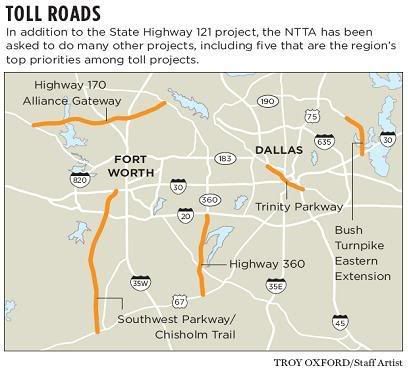
In addition to building the 26-mile State Highway 121 toll road, NTTA has been asked to build or operate at least five other toll roads, and will partner in several other "priced" projects such as pay-to-use HOV lanes.

Critics: Change needed
Critics caution, however, that as NTTA plays a bigger role in solving transportation problems, it will need to do a better job of paying attention to the whole region.

"I have nothing against them, except for their history," said Denton City Council member Pete Kamp, who said NTTA has long ignored Denton and Tarrant counties. "They are telling us that they are now going to be, and I trust them to be, good to their word. But in the past they've simply been in Dallas and Collin counties."

Bill Hale, the engineer in charge of the Dallas district of the Texas Department of Transportation, said North Texas' transportation solutions have long depended on pooling resources from the state, the region's elected officials and the toll authority. "It's a three-legged stool, and everyone has a role to play," he said.

If that's true, NTTA's leg is about to get a lot stronger, as Mr. Hale conceded in an interview last week.

And that means it will be under more scrutiny, said Mike Nowels, a former Regional Transportation Council member from Lewisville. Answerable only to an independent board of directors, the authority has had too little oversight, he said.

"Does the Dallas North Tollway from [Interstate] 635 south into Dallas, is it really up to standards? Is it anywhere close?" Mr. Nowels asked. "Why hasn't the tollway authority invested in fixing it? It's gridlock every morning and gridlock every evening – and it's been that way for 20 years."

Optimism
NTTA officials and Mr. Morris said negotiations over Highway 121 are well ahead of schedule. An agreement is expected to be ready before the Texas Transportation Commission meets in Sugar Land on Thursday – a month before the deadline.

If the deadline is not met, the contract will go to Cintra, the Spanish firm that won preliminary approval in February to build the road.

Many of the Regional Transportation Council members who voted to let Cintra keep the contract said they now think NTTA will do a good job.

Mesquite City Council member John Heiman Jr. said many of the "no" votes were cast in opposition to the way NTTA was allowed to make a late bid after Cintra had been named the preliminary winner.

"I didn't vote against the NTTA; I was simply opposed to the process. It was awful," Mr. Heiman said.

Most RTC members have put the differences over Highway 121 behind them and are focused on building the region's badly needed roads, he said.

"There is so much need – and I am not talking about wants, I am talking basic needs of transportation – we're going to need a big head of steam to get it all done," Mr. Heiman said.

Mr. Morris said NTTA must be given the support it needs to live up to its commitments on Highway 121 and other roads it has promised to help build.

"We want them to succeed," Mr. Morris said. "We're going to do everything we can to assist them."

NTTA chairman Paul Wageman said board members have benefited from criticism.

"I think it has been very instructive, and we're changing," Mr. Wageman said. "We're having to grow and adapt to a changing environment. Perhaps we were a little slow to adapt to that as a board, but the board is now fully focused on our road ahead."


That path ahead, he said, includes an increased focus on communities in Tarrant and Denton counties who have long felt ignored by NTTA.

Higher tolls ahead

Still, what has changed most of all is not NTTA, but the way local officials and transportation planners have so enthusiastically embraced tolling as a road-building strategy.

That would have been hard to imagine in June 1997, when the Legislature voted to create NTTA.

Former Dallas County Judge Lee Jackson helped lead the charge to persuade lawmakers to dissolve the Texas Turnpike Authority and replace it with NTTA.

At the time, the authority's only job was to maintain the Dallas North Tollway and collect millions of dollars in tolls. In time, it used those funds and others to build the President George Bush Turnpike, and has since embarked on a handful of other, smaller projects.

But Mr. Jackson, chancellor of the University of North Texas system since 2002, said the philosophy about the role of toll roads in the highway system a decade ago barely resembles what has emerged since the Highway 121 debate began.

"When the NTTA was formed, the idea was that every toll road would be built and operated to the lowest possible cost to the drivers," Mr. Jackson said. "The idea was to set the smallest possible toll rates."

These days, the idea is to set the toll rates high enough to create a rich revenue stream that can be used as collateral for massive upfront loans from banks or bondholders.

In the Highway 121 case, for example, NTTA has promised to pay the state $3.3 billion in cash to help finance a stream of other North Texas projects. The money will come from the sale of bonds secured by future toll revenue that exceeds what is needed to build and operate Highway 121 in Denton and Collin counties.

"Obviously money talks," Mr. Jackson said. Still, he said the new approach is necessary because of the paucity of funds from more traditional sources such as state and federal gas taxes.

Mr. Morris agreed.

"We're in such a financial crisis when it comes to transportation that the gas taxes are basically paying for the maintenance of the roads we already have," Mr. Morris said. "Ten years from now the only improvements we will be able to make will be the ones that are paid for by toll roads."

Fairness of toll rate
Some local leaders say they can stomach the increasing number of toll roads. But they say it's wrong to abandon the old policy of keeping toll rates as low as possible.
Frisco City Manager George Purefoy is among them. It's bad enough, he said, that Frisco's two main avenues to the rest of the Dallas-Fort Worth area – Highway 121 and Dallas North Tollway – both will be tolled.

But what's worse, he said, is that Frisco drivers will be paying artificially high rates just so NTTA can borrow the billions it has promised to pay upfront. He says the higher toll rates amount to an extra tax on drivers unlikely to use the roads on which the extra money is spent.

"Everyone wants to keep focusing on how much money the region is getting from this project, and no one seems to care how much more drivers are going to have to pay," he said. "Our drivers are going to have to pay a toll, an extra tax and then the gas tax, too."


The Frisco City Council is considering filing suit to try to block the toll road, Mayor Mike Simpson said, but no decision has been made.

Last week, Mr. Morris said that legal threat could make it more difficult for NTTA to close the Highway 121 deal within the deadline.

In the meantime, drivers may need to get used to paying higher tolls – a price transportation officials such as Mr. Morris said is needed if residents want to ease the congestion that continues to clog North Texas roads.

Read more

Sunday, July 22, 2007

Spending Campaign Cash 2007: Senator Brimer

Bay Area Houston blog - Friday, July 20, 2007
Spending Campaign Cash 2007: Senator Brimer

Senator Brimer (R-Ft Worth) has been in the news for spending his donors money on a condo owned by his wife at Westgate Condominiums 1122 Colorado St, Austin Texas. The Ethics Commission's rules are very clear:

§ 253.038. Payments Made to Purchase Real Property Prohibited

(a) A candidate or officeholder or a specific-purpose committee for supporting, opposing, or assisting the candidate or officeholder may not knowingly make or authorize a payment from a political contribution to purchase real property or to pay the interest on or principal of a note for the purchase of real property.


Over the last 6 years he has paid over $176,000 to "J B Realty", "JKB Realty", and "Janna Brimer Realty" for rent. These are names of a realty company owned by his wife, Janna. In his July 2007 report, something has changed.

For Jan and Feb he paid JKB Realty over $2900 a month for condo rent. JKB Realty has the mailing address of 1600 W. 7th St Fort Worth Tx 76102, the same address for Senator Brimers Ft Worth office. But for Mar-Jun he spent just over $700 a month to Westgate Condo Assoc for "Condo dues". This is the same condo where his wife owns property.

He has also paid Ed Shack over $6000 for campaign legal services in the past 6 months. Go figure.

Earlier post: Spending campaign cash: Senator Brimer
Bay Area Houston - Wednesday, May 16, 2007
Senator Brimer is one of a very few who use their campaign contributions to pay his spouse rent for a condo. Over the last 6 years he has paid over $176,000 to "J B Realty", "JKB Realty", and "Janna Brimer Realty" for rent. These are names of a realty company owned by his wife, Janna.

Under the Texas Ethics Commission, it is against the law to use your campaign contributions to pay your spouse for real property purchases, but according to the Fort Worth Star Telegram he has found a gaping wide loophole and is exploiting it with his contributions:

Brimer appears to be in a unique situation: He made special property separation arrangements in a pre-nuptial agreement with his wife, Janna Brimer. They publicly disclosed a 1996 "partition" agreement making the Westgate condo and any future proceeds from it her exclusive property.

Brimer appears to be in a unique situation: He made special property separation arrangements in a pre-nuptial agreement with his wife, Janna Brimer. They publicly disclosed a 1996 "partition" agreement making the Westgate condo and any future proceeds from it her exclusive property.

Brimer's lawyer, Ed Shack, acknowledged that there is nothing to block politicians who leave office from benefiting from what was once separate property. But he noted in a letter to Brimer last week that the law gives legislators special legal protection when they use Ethics Commission opinions as guidance in transactions.


That is the same Ed Shack who is representing State Representative Davis, Speaker Craddick, and many more elected officials. Shack is making good money defending those who take money from their contributors to purchase items for themselves.

Other than the $176,000 paid to his wife, Brimer has paid over $12,000 to GMAC for a vehicle lease, nearly $6000.00 for Christmas gifts, a Christmas mailing for $9300, and $4400 for membership in the Fort Worth Club. He also took a $9500 expense for donating a 1976 Cadillac to Huguley Crystal Heart Gala, for a fundraiser.

TxDOT’s Sunset Review Kick-Off Party & Media Blitz

tKeeping An Eye on Williamson County - Friday, July 20, 2007
In what looks like a media blitz to show that TxDOT was right all along, and to justify it’s continuing existence in relation to it’s upcoming Sunset review, TxDOT this week is holding it’s Texas Transportation Forum toll-gasm conference.

Much of the focus has been on a draft report of a soon to be released “independent” report - TxDOT paid $3.5 million for the report - that says:

Texas needs more toll roads, and drivers should pay more to use them, an external audit of the Texas Department of Transportation suggested Wednesday.

(Kuff’s response):
I like that “priced to reflect the value - including the time saved” line. Because, of course, if you keep your toll roads expensive enough to guarantee that they’re never crowded, then it’s a self-perpetuating justification. Better yet, if you ensure that the remaining non-toll roads are sufficiently decrepit and jammed up, you’ll also have a built-in reason to keep raising tolls in the future. What more could a local toll road authority want?

A TxDOT paid for “independent” audit that reaffirms TxDOT’s toll every road stance. That’s just a happy coincidence for TxDOT I’m sure. Although the forum is billed as a chance to, “Experience the vision. Share your ideas. Join the conversation. Keep Texas moving”, in reality it appears to be more a way to bring lawmakers and those who make money off of government transportation deals together:

…the need for toll financing and other alternatives to gasoline taxes is a major theme of the conference that brought together public officials and private contractors from across the state.

The audience that packed the Hilton ballroom found in each chair a Texas Department of Transportation brochure titled “TxDot: Open for Business — A Guide to Accelerating Transportation Projects.” [.PDF]

The booklet explains various strategies approved by the Legislature in 2003 to supplement tax revenue with toll financing, public-private partnerships and regional mobility authorities.

The conference coincided with the release of an audit by TxDOT, suggesting the state’s best chance for keeping up is to build more toll roads with higher fees.

Now the report, as Move It! explains, has one point that may be worth further exploration. It’s a plan based on making ALL drivers pay a user fee based on vehicle miles traveled:

A long-term answer is to switch from a tax on gas to a tax on how much people drive, called a vehicle miles traveled charge or VMT charge. Oregon finished testing such a system in March and a report is due this summer.

“Texas needs to lay the ground work to move to a VMT charge over the next 20 years,” the report says. (see Oregon Test [.PDF]).

The technology for the implementation may still be a little ways off but this has the potential to be a fair, broad-based tax that charges drivers for the amount of driving they do.

One last thing. Gov. Perry was quoted as saying this:

And the fuel tax “has problems on its face,” he said. Unlike toll roads, which typically have a free alternative, fuel taxes are paid by all drivers, and hit rural residents hardest.

“The boys out in Lubbock, Odessa and Marfa really don’t see the benefit in it for them,” he said.

When Gov. Perry runs around the state telling Texans that we have to build the Trans-Texas Corridor, and take away precious farmland and family legacies, he says it must be done to benefit all of Texas. The “conservative” staple excuse of using economic development as the reason when it benefits their cause. But in those sentences he’s refuting that statement by saying that toll roads only benefit urban/suburban Texans. Which is it governor? Either our highways are built for the benefit of ALL Texans and should be funded by ALL Texans or they shouldn’t. You can’t have it both ways.

Again I’ll refer you back to EOW’s earlier post on the “independent” audit, It’s Not The Size Of The Shorfall, It’s How It’s Made Up That Matters. No matter how we want to slice it, the ultimate question is, How do Texans want to pay to make up for the disrepair and neglect our state leaders, and ultimately ourselves, have allowed our transportation infrastructure to fall into in this state? EOW believes the best way to do this is in the fairest, and most broad-based, way possible, which at this time happens to be raising and indexing the gas tax.

Read more

Friday, July 20, 2007

Perry reiterates toll road support

Governor tells builders the need for road funds will overcome critics
By RAD SALLEE - Houston Chronicle - July 19, 2007


AUSTIN — Gov. Rick Perry told road builders at the Texas Transportation Forum here Thursday that he stands firm in his support for toll roads and public-private partnerships despite some setbacks in the past legislative session.

"When you have big dreams," he said, people tell you, "You can't get there from here. But I assure you we can get there from here, and we're going to get there together."

Perry said traditional sources of road funding — "a trickle of federal funds and a gas tax that few legislators would even think of raising" — aren't nearly enough to meet the state's needs.

"There isn't even enough money to maintain our current system," he said.

And the fuel tax "has problems on its face," he said. Unlike toll roads, which typically have a free alternative, fuel taxes are paid by all drivers, and hit rural residents hardest.

"The boys out in Lubbock, Odessa and Marfa really don't see the benefit
in it for them,"
he said.


"If we don't build roads with innovative financing and tolls, roads are not going to be built in our state," he said.


Driving the private sector

Perry said even the prospect of the state contracting with the private sector to build and operate toll roads is paying off.

"Projects that local toll road authorities would not have bid on a few years ago are now attracting very strong interest because private companies are now competing to build those same projects," he said.

This was an apparent reference to the North Texas Tollway Authority's offer to pay the state $3.3 billion to build and operate for profit in a 50-year lease, a segment of Texas 121 in the Dallas area. The offer topped a previous $2.8 billion bid from the Spanish firm Cintra.

"They may never say it," Perry said of lawmakers opposed to such long-term public-private toll partnerships, "but the Legislature admitted we were on the right track.

"While they were calling for a moratorium on toll roads, on one hand, they were insisting on toll road projects in their own districts because their constituents wanted to see things moving. They wanted to see those roads built."
Read more

Tuesday, July 17, 2007

Judge who didn't report campaign finances fined - Democrat who has said he opposes fundraising must pay $38,000

By MICHAEL GRABELL - The Dallas Morning News - Tuesday, July 17, 2007


A Dallas civil court judge has been sanctioned by the Texas Ethics Commission for failing to file campaign finance reports in the 2006 election. And now the Texas attorney general and a state judge are demanding that he pay $38,000 in fines and court fees.

Judge Bruce Priddy, one of 42 Democratic judges elected in Dallas County in November, has said that he is philosophically opposed to the idea of judges asking people for money. He did not return calls Tuesday, but he said in February that he didn't think he had to file reports because he didn't raise any money.

The judge has since held a fundraiser in which lawyers were invited to hear a polka band and dance the hokey pokey. It's unclear how much he raised at that event because he didn't file the report due Monday, according to the ethics commission.

"Our concern here is the fact that he owes this money to the state of Texas and the fact that he has ignored a judge's order," said Tom Kelley, a spokesman for Attorney General Greg Abbott's office.

Elected officials and political candidates are required to file campaign finance reports to show the public who gives them money and how they spend it.

Because Texans elect their judiciary, it's important for judges to comply with the law, said Craig McDonald, director of Texans for Public Justice, a watchdog group that tracks campaign donations.

"Half or more of their money historically comes from people who have cases in their courtrooms, which presents a horrible conflict of interest," he said. "Disclosure is the best tool we have for accountability."

Judge Priddy was fined $30,500 for failing to file four reports between July 17, 2006, and Jan. 16. The attorney general sued him in Travis County in April.

But Judge Priddy never responded to the lawsuit, and State District Judge John Dietz granted the state a default judgment, ordering the Dallas judge to pay the $30,500 fine and $7,500 in attorney's fees and court costs.

Tim Sorrells, spokesman for the ethics commission, said Judge Priddy hasn't responded to state officials.

"We send a notice to file the report to all the filers, and if the report is late, we send them a late notice," he said. "If the report is still not filed, we'll send a notice saying that we're going to refer it to the attorney general's office."

The state has the option of freezing the judge's bank accounts if the fines aren't paid. And he could face discipline from the state Commission on Judicial Conduct.

Judge Priddy's situation is similar to that of Texas Court of Criminal Appeals Judge Paul Womack, who said he raised so little money in his 2002 campaign that "the public interest was not significantly harmed by the delay" in filing seven required reports.

The judicial conduct commission publicly condemned Judge Womack after he told the commission he had attention deficit disorder and a procrastination problem.

During the campaign, friends and colleagues described Judge Priddy as one of the most ethical and upstanding candidates – someone who avoided almost all politicking to prevent the appearance of a conflict of interest.

In 2002, while still an attorney, he donated nearly $400,000 to agencies that help the homeless after winning a verdict for thousands of apartment residents who were overcharged for water, according to an article on the state bar Web site.

"I really think it's a philosophical issue with him," said Darlene Ewing, chairwoman of the Dallas County Democratic Party. "He thinks the judiciary should be totally free of campaign contributions."

Regardless of intentions, Ms. Ewing said, she expects all Democratic officeholders to file the reports.

Judge Priddy has had other problems since taking office. For several weeks in April, the State Bar of Texas, which licenses lawyers, listed him as suspended for failing to complete his legal education requirements.

But it turned out that the judge just hadn't filled out the correct form to change his status from lawyer to judge.

Despite the judge's statements against raising money, he did hold a fundraiser after the election.

His Web site invited the public to "blow out" the campaign season at "the one and only" fundraiser for Judge Priddy. The March 6 event at the Hickory Street Annex near Fair Park featured the polka band Brave Combo and "upscale festival food with cold beer."

"Where else can you mingle with the greatest legal minds in the area AND do the hokey pokey?" the invitation read. "Guaranteed to be the most fun you have ever had at a judicial candidate fundraiser!"

"Of course, any contributions would be appreciated, but $ is not necessary," the Web site said.
Staff writer Diane Jennings contributed to this report
Read more

Regional Transportation Council's chairman slowing down to speed things up

By O.K. CARTER - Star-Telegram Staff Writer - Thu, Jul. 05, 2007
North Richland Hills Mayor Oscar Trevino is only 30 days into his role as chairman of the Regional Transportation Council, but he's already discovered that leading the council resembles herding whales: It takes a while, and some whales always wander off in new directions.

Last month's vote to recommend a builder and operator of a future Texas 121 toll road, for example, was 27-10 in favor of the North Texas Tollway Authority, with some of the 10 voicing adamant opposition. Regional transportation issues rarely achieve consensus because interests and needs are so varied.

The council, part of the North Central Texas Council of Governments, is the chief planning agent for future regional transportation needs: highway improvements, toll roads, regional passenger rail and the like. The regional council's 40 members include elected or appointed officials from 16 Metroplex counties, as well as representatives from transportation planners like The T or Dallas Area Rapid Transit. Nothing big in regional transit happens without the regional council's endorsement.

"The process of getting things done in regional transportation is miserably slow, like watching grass grow," the thrice-elected North Richland Hills mayor jokes. It helps that he's also a civil engineer and highway construction expert.

It's already obvious that Trevino's style is to speed up by slowing down, giving council members plenty of time to get their say. His first meeting ran almost four hours. It's a hypothesis that long meetings equal faster projects.

"Letting members have their say and having open civil discussions may result in meetings going a little long," Trevino concedes. "But when everybody can present positions and have them openly debated, even members that don't get things 100 percent their way will know that we hashed it out and gave them a fair shake."Trevino knows that at the same time, the clock is ticking on transportation issues and speeding up projects is crucial.

A recent census study revealed that the percentage of people commuting to work in a vehicle by themselves actually increased by 2 percent over the past five years. The population of the Metroplex is projected to increase 3.5 million over the next three decades.

"More cars and people add to pollution and congestion problems," he said.

Trevino's watch as council chairman did not begin on a cheerful note. A pitch to the Legislature to allow Metroplex residents to vote on a half-cent sales tax to fund regional passenger rail was essentially ignored.

"If transportation planning moves slow, the Legislature moves even slower," Trevino said. "If you want something done in one session, you have to introduce it an earlier session. Basically, all we're asking is that the Legislature allow voters here to make that call."

Without the tax, Trevino sees no way to fund regional rail, which is why one of the top two priorities of his council term will be to organize a more focused and determined legislative lobbying effort two years from now to get lawmakers to allow a vote on a tax.

The other priority? When he hands over his gavel to a new chairman in 11 months, Trevino would love it if the tollway authority had resolved not only the 121 issue, but had also established firm timetables for toll road projects, including a widening of Texas 360 in southeast Tarrant (Arlington/Mansfield), Texas 171 in north Fort Worth and north Tarrant County, and the Southwest Parkway. He'd also like the tollway authority to pick up the pace on a George Bush Freeway extension and the Dallas Trinity Parkway project.

"It's also obvious that [the Texas Department of Transportation] is going to have to recognize that it's going to have to take care of some mobility issues without assistance from tolls, including problems on I-35, Loop 820, S.H.183 and the downtown funnel," Trevino said, though with a proviso: He favors construction of toll-funded express lanes on 820.

That's much to do with less than a year to do it.

O.K. Carter's column appears Tuesdays and Thursdays.
Read more

Food Imports Don't Get Enough Oversight by U.S., Lawmakers Say

By Justin Blum - Bloomberg - Tue., Jul 17, 2007
The U.S. Food and Drug Administration doesn't have enough staff to protect Americans from tainted food imports, lawmakers and congressional investigators said.
The FDA inspects less than 1 percent of imported food and takes samples of only a fraction of those products, said Representative Bart Stupak, a Michigan Democrat and chairman of a House panel holding a food-safety hearing today in Washington. The FDA plans to close seven of 13 labs that inspect food as well as other imports, posing new dangers, he said.

The FDA is under criticism from lawmakers who say the agency didn't do enough to protect the public from contaminated spinach last year and tainted peanut butter and pet food this year. The agency also was slow to react to contaminated seafood from China being shipped to the U.S., they said.

``FDA's food-safety program is woefully understaffed,'' said Stupak, chairman of the Energy and Commerce Subcommittee on Oversight and Investigations. ``Entry reviewers, investigators and compliance officers simply cannot keep up with the flood of imported food.''

The FDA shouldn't go forward with plans to consolidate labs, said David Nelson, an investigator with the Energy and Commerce Committee, during the hearing. The agency hasn't provided proof that the closures would save money, he said.

In San Francisco, four reviewers oversee thousands of shipments of products regulated by the FDA every day, according to a report by committee investigators released at the hearing. In a typical day, an FDA reviewer examines one entering line of food and other products every 30 seconds, the report said.

`Fragmented, Understaffed'

``The Federal food-safety system is in dire need of reform: It is fragmented, understaffed, inefficient, and lagging in state-of-the-art tracking systems,'' said John Dingell, a Democrat from Michigan and chairman of the Energy and Commerce panel, at the hearing. ``FDA has largely abdicated its regulatory role to the food industry itself, which is expected to police itself.''

The FDA has ``done a great deal'' to protect the U.S. food supply from contamination, said Andrew von Eschenbach, the agency's commissioner, in prepared testimony. The FDA is working to develop new strategies designed to bolster the country's food safety system, he said.
Read more

20.5M decisions to classify documents

By PETE YOST - Associated Press Writer - Mon Jul 16, 2007

WASHINGTON - There were 20.5 million decisions to classify government secrets last year, and a report to the president found serious shortcomings in the process.

The Information Security Oversight Office said more than 1 in 10 documents it reviewed lacked a basis for classification, "calling into question the propriety" of the decisions to place them off limits to public disclosure.

"The high error rate," the ISOO said in its annual review, can only be addressed by a multifaceted effort and continuous oversight.

The report comes as the office of Vice President Dick Cheney is refusing to cooperate with the office of the National Archives. The report noted that Cheney's office "did not report data to ISOO this year."

Executive branch agencies give the ISOO data on how much material they classify and declassify. Cheney's office provided the information in 2001 and 2002, then stopped.

"The reviews of actual decision making are striking, given the vice president's refusal to report" to the ISOO, said Meredith Fuchs, general counsel at the National Security Archive, a private group advocating public disclosure of government secrets.

The White House says it's clear that the president's executive order on the matter never intended for the vice president's office to be treated as an agency.

The ISOO said the Pentagon reported a 35 percent decline in its activity to classify documents, and that the amount of classification government-wide declined for the second straight year.

However, the amount of derivative classification activity rose by more than 6 million actions.

Derivative classification is the act of incorporating in a new form information that has already been classified.

Read more

Fair Use

FAIR USE NOTICE: This site contains copyrighted material the use of which has not always been specifically authorized by the copyright owner. Material from diverse and sometimes temporary sources is being made available in a permanent unified manner, as part of an effort to advance understanding of the social justice issues associated with eminent domain and the privatization of public infrastructure. It is believed that this is a 'fair use' of the information as allowed under section 107 of the US Copyright Law. In accordance with Title 17 USC Section 107, the site is maintained without profit for those who access it for research and educational purposes. For more information, see: http://www.law.cornell.edu/ To use material reproduced on this site for purposes that go beyond 'fair use', permission is required from the copyright owner indicated with a name and an Internet link at the end of each item. [NOTE: The text of this notice was lifted from CorridorNews.blogspot.com]

See ARCHIVE on side bar

Content is being archived weekly. Many pertinent articles regarding Transportation in the DFW Region are in the archives.

A government big enough to give you everything you want, is strong enough to take everything you have. - Thomas Jefferson

The Opnions On this Site are Diverse

DFW Regional Concerned Citizens attempts to examine issues from all directions. When a story says "By Faith Chatham" it contains my viewpoint. When it is by others, but posted by Faith Chatham, it is from someone else's viewpoint. When I discover contents which is on topic for this site, I frequently link to other sites. Usually those sites contain content which differs from my viewpoint (and frequently that of other members of DFW-RCC).