By Paul Nussbaum - Philadelphi Inquirer Staff Writer - Jun. 22, 2007
HARRISBURG - Democratic legislators, narrowly in control of the state House, pushed yesterday for new funding for mass transit and highways, setting the stage for a battle with the Republican-controlled Senate.
Rather than lease the Pennsylvania Turnpike to a private company to raise the money, as requested by Gov. Rendell, the House plan would expand the turnpike commission's domain by making Interstate 80 a toll road.
And it would call for more local funding for transit, with authority for local governments to raise taxes to pay for it.
An initial vote on the measure was delayed until Monday, after contentious debate on the House floor that lasted until nearly 11 p.m. If it receives initial approval on Monday, the bill would still face a final vote before it could be sent to the Senate.
SEPTA officials, facing the prospect of steep fare hikes and service cuts without $100 million in additional state money, were cautiously optimistic that lawmakers were moving toward a solution. But they weren't popping any champagne corks yet.
"We're very pleased that we're seeing a lot of activity, but we're not there yet," SEPTA general manager Faye Moore said yesterday.
The House bill would provide about $102 million more in operating funds for SEPTA for the budget year that begins July 1.
The bill would fund transportation by borrowing against future toll increases on the Pennsylvania Turnpike and newly created tolls on I-80 across northern Pennsylvania. The increases and new tolls would be deferred until 2010.
Any tolls on I-80 would require approval by the Federal Highway Administration.
Tolls on the turnpike would rise by 25 percent in 2010 and about 2.5 percent a year after that. Tolls on I-80 would be set at the same per-mile rate (currently about 8 cents a mile) as those on the turnpike.
The House bill would raise an estimated $705 million in the next fiscal year, with $305 million earmarked for transit and $400 million for highways and bridges. The total funding is expected to rise to $900 million by 2010.
The amounts fall well short of $1.7 billion a year that a state panel calculated was necessary to repair highways and bridges and shore up mass-transit systems. Rendell proposed to raise $965 million a year for highways by leasing the turnpike and $760 million a year for transit by imposing a tax on oil company profits.
The House proposal, a 57-page amendment by majority whip Rep. Keith McCall (D., Carbon) to House Bill 1590, would increase funding from local governments (to 20 percent from the current 13 percent of state funding) and would authorize them to raise money by increasing the realty transfer tax, the earned income tax, the sales tax, or a parking surcharge.
The measure would also increase Philadelphia's clout on the SEPTA board of directors. The board would be increased from 15 members to 21, and counties would be allotted members on the board according to their share of local funding, up to eight members for counties that provide at least 50 percent of the local funding. Currently, Philadelphia provides 80 percent of the local operating funding to SEPTA.
Rep. Tom Killion (R., Delaware), a former SEPTA board member, criticized that change.
"We're about to shift all the power on that board to the city of Philadelphia," Killion said. He said the change would remove the incentive for the five counties to work together to run SEPTA.
And Rep. Mario Civera (R., Delaware), the ranking Republican on the appropriations committee, asserted that the change was "a Philadelphia grab. . . . Don't push this down our throats."
Rep. Dwight Evans (D., Phila.), chairman of the House Appropriations Committee, was conciliatory, telling Civera that "this is only the first step in a long negotiation. . . . We're going to work together."
With eight days left in the budget year, Evans reiterated his vow to block passage of a new budget unless the Senate approved funding for mass transit this month.
"They can't wait till fall," Evans said in an interview yesterday.
Senate Republican leaders indicated little desire to immediately tackle the funding issue. "I don't know that it can get approved in the next week, and I don't know that it's a crisis if it doesn't," said Erik Arneson, spokesman for Senate majority leader Dominic Pileggi (R., Delaware). "Sen. Pileggi's goal is to address this, but not in a way that makes members feel rushed."
Read more in the Philadelphia Inquirer

Thursday, October 25, 2007
Wednesday, October 24, 2007
T.U.R.F. Press Cconference video on Federal Lawsuit against San Antonio Metropolitan Planning Organization
TURF to sue transportation board for equal protection
MPO Board composition violates First and 14th Amendments to U.S. Constitution
By Terri Hall - T.U.R.F. - Oct. 23, 2007
San Antonio, TX, Monday, October 22, 2007 – In what could change the way toll roads are decided and approved in Bexar County, TURF filed a NEW lawsuit in FEDERAL COURT to put the power over transportation decisions back in the hands of the PEOPLE. TURF recently scored a victory in STATE COURT in a different lawsuit (read it here) against members of the Texas Transportation Department and Transportation Commission.
A lawsuit has been brought against the San Antonio Metropolitan Planning Organization (SAMPO) Transportation Policy Board that allocates tax dollars to transportation projects and approves toll rates and toll projects and San Antonio Councilwoman and MPO Chair Sheila McNeil. The lawsuit alleges that the composition of the SAMPO Board is unconstitutional and Chairwoman McNeil has been a party to denying the First Amendment right of free speech to the constituents of elected MPO Board members like State Representative David Leibowitz by blocking an agenda item and any debate on an issue brought up at his request. This novel lawsuit cuts to the heart of how toll roads are approved.
It’s based upon the First and Fourteenth Amendments to the United States Constitution, 28 U.S.C. §1331, and 28 U.S.C. §§1343(3) and (4). The section of the post-Civil War civil rights enactments codified as 42 U.S.C. §1983 provides the Plaintiff’s enabling cause of action. A faction of governmental officials with the help of unelected board members have shut citizens and voters who oppose toll roads out of equal participation in the political process. The case will also argue that actions like Chairwoman McNeil’s removal of an agenda item asking for the funds TxDOT is spending on the Keep Texas Moving ad campaign be returned to building roads.
By way of recent example, in a SAMPO Transportation Policy Board meeting of September 24, 2007, Defendant McNeil, using the badge of authority of Chairmanship of the Board, arbitrarily removed from the meeting agenda a motion by State Representative and MPO Board member David Leibowitz calling for SAMPO to object to certain expenditures of public money by TXDOT promoting toll roads, which expenditures Representative Leibowitz believed to be inappropriate.
Defendant McNeil, acting under color of law, removed Representative Leibowitz’s motion from the meeting agenda even though Representative Leibowitz had properly and legitimately placed it on the meeting agenda and SAMPO had included it in the public posting of the agenda pursuant to the Texas Open Meetings Act. Defendant McNeil, acting under color of law, refused to permit Representative Leibowitz to present his motion because of her disfavor of his attempt to provide a voice for his constituents who oppose turning free public highways into toll roads.
TURF will be asking for both a temporary and permanent injunction to suspend ALL activities of the MPO until the case is decided and the Board’s composition is changed to reflect proper Constitutional representation allowing equal protection under the law per the 14th Amendment.
The unconstitutional MPO has blocked agenda items, voted against an independent review of toll plans that would bring accountability to the gross misuse of taxpayer money in these toll plans, voted against restoring the gas tax funded overpasses on 281 (281 in particular DOES NOT NEED TO BE TOLLED, what’s needed are overpasses and they’ve been paid for since 2003, the money is STILL there, they could do it tomorrow, but this un-Constitutional Board persists in preventing the simple solution that’s already paid for!
The MPO Board has also delayed votes, blocked the succession of the next Chair, and changed the bylaws to allow yet more illegal representation on the Board.
“The people of Texas are FED-UP with out-of-control abusive government. We’ve done everything in our power to exert the political pressure to change this unconstitutional Board, but when the deck is stacked and a powerful unelected voting block is allowed to persist unchecked, we have no choice but go to court to address our grievances. This is taxation without representation and we cannot and will not allow it to continue,” says Terri Hall, Founder and Director of TURF.
For a history of the efforts of the pro-toll faction blocking citizens from equal representation:
Click here and scroll to bottom for links to each action.
Chairwoman McNeil strips agenda item requested by State Representative David Leibowitz on expenditures for toll roads (click here.)


Monday, October 22, 2007
TURF sues transportation board for equal protection
By Terri Hall - T.U.R.F. - Oct. 22, 2007
MPO Board composition violates First and 14th Amendments to U.S. Constitution
San Antonio, TX, Monday, October 22, 2007 – In what could change the way toll roads are decided and approved in Bexar County, TURF filed a NEW lawsuit in FEDERAL COURT to put the power over transportation decisions back in the hands of the PEOPLE. TURF recently scored a victory in STATE COURT in a different lawsuit against members of the Texas Transportation Department and Transportation Commission.
A lawsuit has been brought against the San Antonio Metropolitan Planning Organization (SAMPO) Transportation Policy Board that allocates tax dollars to transportation projects and approves toll rates and toll projects and San Antonio Councilwoman and MPO Chair Sheila McNeil. The lawsuit alleges that the composition of the SAMPO Board is unconstitutional and Chairwoman McNeil has been a party to denying the First Amendment right of free speech to the constituents of elected MPO Board members like State Representative David Leibowitz by blocking an agenda item and any debate on an issue brought up at his request. This novel lawsuit cuts to the heart of how toll roads are approved.
It’s based upon the First and Fourteenth Amendments to the United States Constitution, 28 U.S.C. §1331, and 28 U.S.C. §§1343(3) and (4). The section of the post-Civil War civil rights enactments codified as 42 U.S.C. §1983 provides the Plaintiff’s enabling cause of action. A faction of governmental officials with the help of unelected board members have shut citizens and voters who oppose toll roads out of equal participation in the political process. The case will also argue that actions like Chairwoman McNeil’s removal of an agenda item asking for the funds TxDOT is spending on the Keep Texas Moving ad campaign be returned to building roads.
By way of recent example, in a SAMPO Transportation Policy Board meeting of September 24, 2007, Defendant McNeil, using the badge of authority of Chairmanship of the Board, arbitrarily removed from the meeting agenda a motion by State Representative and MPO Board member David Leibowitz calling for SAMPO to object to certain expenditures of public money by TXDOT promoting toll roads, which expenditures Representative Leibowitz believed to be inappropriate.
Defendant McNeil, acting under color of law, removed Representative Leibowitz’s motion from the meeting agenda even though Representative Leibowitz had properly and legitimately placed it on the meeting agenda and SAMPO had included it in the public posting of the agenda pursuant to the Texas Open Meetings Act. Defendant McNeil, acting under color of law, refused to permit Representative Leibowitz to present his motion because of her disfavor of his attempt to provide a voice for his constituents who oppose turning free public highways into toll roads.
TURF will be asking for both a temporary and permanent injunction to suspend ALL activities of the MPO until the case is decided and the Board’s composition is changed to reflect proper Constitutional representation allowing equal protection under the law per the 14th Amendment.
The unconstitutional MPO has blocked agenda items, voted against an independent review of toll plans that would bring accountability to the gross misuse of taxpayer money in these toll plans, voted against restoring the gas tax funded overpasses on 281 (281 in particular DOES NOT NEED TO BE TOLLED, what’s needed are overpasses and they’ve been paid for since 2003, the money is STILL there, they could do it tomorrow, but this un-Constitutional Board persists in preventing the simple solution that’s already paid for!
The MPO Board has also delayed votes, blocked the succession of the next Chair, and changed the bylaws to allow yet more illegal representation on the Board.
“The people of Texas are FED-UP with out-of-control abusive government. We’ve done everything in our power to exert the political pressure to change this unconstitutional Board, but when the deck is stacked and a powerful unelected voting block is allowed to persist unchecked, we have no choice but go to court to address our grievances. This is taxation without representation and we cannot and will not allow it to continue,” says Terri Hall, Founder and Director of TURF.
See history of the efforts of the pro-toll faction blocking citizens from equal representation. (scroll to bottom for links to each action)
Chairwoman McNeil stripped agenda item requested by State Representative David Leibowitz on expenditures for toll roads.
San Antonio attorney David Van Os, is representing TURF.
City of Mansfield changes Debt Collectors due to questionable political campaign contribution
City Council plans to consider hiring new debt collector
By ROBERT CADWALLADER - Special to the Star-Telegram - Oct. 22, 2007
MANSFIELD -- The City Council tonight will consider hiring a Round Rock-based law firm to replace the city's fired debt collector.
The staff has recommended McCreary, Veselka, Bragg & Allen, which collects delinquent property taxes or court fees and fines for about 450 taxing jurisdictions statewide. The firm has no collection clients in Tarrant or Dallas counties.
The council terminated the city's contract with Linebarger, Goggan, Blair & Sampson of Fort Worth on Sept. 28, taking issue with a $2,000 campaign contribution the firm made to Mayor Barton Scott after his election in May. The move apparently did not violate local or state campaign finance laws, but the council called it inappropriate and also voiced concerns about investigations of Linebarger contributions in other cities.
Scott, who blamed council politics for Linebarger's firing, said he will question the recommendation for McCreary because the staff did not conduct a full selection process, including advertising for proposals.
"When we start playing political games with vendors, we are not acting in the best interests of the citizens," Scott said.
Staff officials said they didn't advertise for proposals because the process would have taken at least 90 days. The city has no one collecting back taxes.
As a corporation, McCreary is prohibited by law from making political contributions, a McCreary official said. Although individual employees are allowed to donate to local candidates, no employees will donate to Mansfield public officials, President Harvey Allen said.
That could become the law in Mansfield anyway. A council subcommittee is considering revising the city's ethics ordinance.
"I will tell you, we as a firm get virtually no solicitations for campaign contributions from anybody," Allen said. "And I think that's because we have the reputation of not doing it."
Linebarger, as a limited liability partnership, is allowed to make political contributions.
Read more in the Fort Worth Star Telegram
Sunday, October 21, 2007
Trinity park planners challenged to provide easy access over levees - Bridges, trails suggested as ways to enter planned oasis
By BRUCE TOMASO - The Dallas Morning News - Sunday, October 21, 2007
Designers of the Trinity River project have an ambitious vision.
They say they want to see the river transformed "from the city's back alley to its front yard."
The central element of that vision, for many people, is the proposed downtown Trinity River park. With its lakes, river meanders, hiking trails, canoeing course, greenbelts and promenades, the downtown park, at roughly 100 acres, is often extolled as having the potential to become Dallas' Central Park, or Dallas' River Walk, or Dallas' Town Lake – an urban oasis that will draw visitors from near and far.
Also Online
Interactive map: Trinity toll road issues
Map: Trinity toll road issues (.pdf)
Archive: Learn more about the Trinity toll road fight
But there's at least one big obstacle to that vision – or two, actually – having nothing to do with the Nov. 6 referendum on whether to build a toll road in the park.
Unlike Central Park, or the San Antonio River Walk, or Austin's Town Lake, the Trinity is cut off from the rest of the city by its levees – "two 30-foot mounds of dirt separated by a half-mile of weeds," in the memorable phrase of Paul Lehner, director of planning and development for the city's Trinity River Corridor Project office.
"We can't do exactly what they've done in San Antonio," said Mr. Lehner. "We won't have people who can just step out their doors and be right at the water, because of the levees. For that reason, providing connectivity to the park through a number of points has been very high on our list."
The levees, built in the 1920s and '30s to protect downtown against flooding, aren't going anywhere. In fact, the U.S. Army Corps of Engineers plans to raise the levees by about two feet over the next few years.
The corps has said emphatically that whatever else is done to the river corridor – park, lakes, toll road, no toll road – flood protection remains its primary function.
So to get to the park, folks would have to find ways over those "mounds of dirt."
Dallas being Dallas, many of them would drive. Their access to the park depends very much on what happens Nov. 6, when voters will weigh in on Proposition 1, a ballot measure to scrap the high-speed toll road now planned inside the levees.
Whether that toll road is built – and, if it isn't, what gets built instead – will affect many aspects of the Trinity project, from its funding sources to its build-out schedule to the aesthetics of the park to transportation through and to the central city. One of few things that both sides agree on in the toll road debate is that a lot of uncertainty looms – and a lot of recalibration will have to take place – if Proposition 1 passes and the toll road is scrapped.
In ways big or small, the vote could alter almost everything and anything about the park. So all of what follows is open to change. There are lots of things we simply don't know about how the Trinity project might look.
But for now, let us forget about toll roads, figuratively park our cars, lace up our walking shoes and take a stroll through some of the plans for ways that Dallas residents would be able to get to, and enjoy, their park on foot.
Reunion Overlook
This would be one of the prime entry points to the downtown park – and, Mr. Lehner hopes, a gathering point in and of itself.
Reunion Boulevard is the short roadway off Houston Street that now passes the Hyatt Regency Dallas, Reunion Tower and Reunion Arena before dead-ending at Industrial Boulevard.
Under its plans, the city would extend the boulevard another few hundred feet to the west, to the river levee. There, a building of some sort could be built – there is no final design now – at the level of the levee top. The building could house an information center, perhaps a history museum of the Trinity River, perhaps concession stands. From it, there would be "vertical access" via elevators or stairways, down into the river bottoms. At that point, visitors would be in the park, at the promenade along the water.
Mr. Lehner told a City Council committee last week that the Reunion Overlook could evolve into the main "linkage between downtown and the Trinity Corridor."
The trails
The park is to include a network of trails – some near the water and some, perhaps, along the tops of the levees.
Near Sylvan Avenue, these trails would connect with the Trinity Strand Trail, a new trail network being built just outside the levees, behind the Stemmons Freeway along the original, meandering channel of the Trinity River.
The Trinity Strand Trail, in turn, would eventually hook up with the Katy Trail at a point just north of American Airlines Center.
That means hikers, joggers, bicyclists and roller-skaters could come down the Katy Trail from as far away as Southern Methodist University – and eventually farther, as the Katy Trail expands – and get into the Trinity park.
And from the Knox-Henderson neighborhood south, those visitors would never have to cross a vehicular road, said Mike Kutner, chairman of Friends of the Trinity Strand Trail, a group raising private money to complete the trail.
He also noted that there are 13 hotels, including the huge Hilton Anatole, along Stemmons Freeway within a short walk of the Trinity Strand.
"For visitors to our city to be able to walk out of their hotel and get on these trails and enter the park – that would be fantastic," he said.
DART
The Dallas Area Rapid Transit station at Eighth and Corinth streets in Oak Cliff is the southernmost station that jointly serves DART's red and blue rail lines.
The station is close to the Trinity, near where the downtown levees stop.
It's also adjacent to an abandoned railroad trestle. That old railroad bridge, city officials said, could be converted to a pedestrian bridge. Visitors from as far away as Garland or Plano could ride DART to Eighth and Corinth and use the pedestrian bridge as a way into the river bottoms.
At that point, they'd be near the northern boundary of the Great Trinity Forest, an unspoiled hardwood stand covering several thousand acres that the city is assembling. A canoe launch into the river channel is also planned at Moore Gateway Park, near the trestle.
Continental Avenue
Work has just begun on the Margaret Hunt Hill Bridge, a soaring structure by Spanish architect Santiago Calatrava that will extend the Woodall Rodgers Freeway west over the Trinity to Singleton Boulevard.
It's the first of three Calatrava "signature" bridges over the Trinity that planners hope to see completed someday. The others are at Interstate 30 and Interstate 35E.
The Margaret Hunt Hill Bridge will cost an estimated $115 million, according to the city. It's being built with $28 million in city bond proceeds, some funds from state and federal agencies, and a lot of private donations, notably from the family of Ms. Hill, the oil heiress and Dallas philanthropist who died this summer.
When the bridge is completed, the plan is to close the adjacent Continental Avenue viaduct to cars, allowing only pedestrians and bicyclists to use it.
From the east (downtown) side, the Continental bridge would provide a ready way into the park from the West End, Victory and Uptown.
On the West Dallas side, the city would build a "gateway park" that would afford spectacular park views, framed by the downtown skyline in the distance and the Calatrava bridge in the foreground.
"That becomes the Dallas postcard," Mr. Lehner said.
People walking or biking over the bridge would be directly above one of the man-made lakes that are planned as key features of the park.
"The experience," Mr. Lehner said, "will be unlike anything that you can see now in the city."
Oak Cliff
The West Dallas gateway park is one of several spots on that side from which people could enter the park. Another is a planned observation deck that would be built in North Oak Cliff, near Beckley Avenue and Commerce Street, so people could come and watch the progress as the park is built.
"It's the proverbial hole in the construction fence," Mr. Lehner said.
But really, said Bob Stimson, a former City Council member who heads the Oak Cliff Chamber of Commerce, almost anyplace along the levee on the Oak Cliff side would provide ready entry.
"When it comes to accessing the park, Oak Cliff is in a perfect position," he said. "At any number of spots, you'll be able to just walk up over the levees and enjoy this park."
He said that unfettered access is one reason the chamber supports the current Trinity River project plan, which puts all of the highway lanes on the downtown side of the river.
Mr. Stimson said he hoped that Oak Cliff's open access to the Trinity park would "give us a tremendous advantage in the eyes of developers. They'll be salivating at the chance to build over here."
TRACKING THE TRINITY TOLLWAY VOTE
What am I voting on? Passage of Proposition 1 would create a Dallas ordinance prohibiting the construction of a high-speed toll road within the Trinity River Corridor's earthen levees. If the proposition passes, any road built within the corridor would be limited to four total lanes with a 35 mph speed limit.
When to vote: Early voting on Proposition 1 begins Monday and runs through Nov. 2. Regular voting for the referendum is Nov. 6. Only registered Dallas voters may participate.
A "FOR" vote means: You want to prohibit the high-speed toll road's construction within the Trinity River's levees.
An "AGAINST" vote means: You want to preserve the current Trinity River Corridor plan, which calls for construction of the high-speed toll road within the levees.
What supporters of Proposition 1 say: A high-speed toll road would irreparably harm an adjacent urban park also planned as part of the city's broader Trinity River Corridor project. The road could be built outside the levees, along Industrial Boulevard, or elsewhere.
Supporters of the proposition say that since Dallas is endowed with a massive, empty greenspace in its city center, it should use its prime opportunity to develop it to create an urban oasis, unadulterated by a loud, unsightly highway carrying tens of thousands of vehicles each day.
They also say the toll road may be prone to flooding and would lead to more air pollution in downtown Dallas.
What opponents of Proposition 1 say: Removing the toll road from the larger Trinity project is akin to yanking on threads from a suit: It'll soon unravel.
Private funding for the park element, as well as county, state and federal funding for transportation components both related and unrelated, are contingent on the toll road being built as planned. Passage of Proposition 1 could also delay the project, which was originally passed in 1998, for years.
Opponents of the proposition say that building the road elsewhere could cost hundreds of millions of dollars more, and not building it at all would lead to unacceptable traffic congestion in downtown Dallas.
Voter turnout? Both sides expect it to be low, meaning individual votes carry more strength than in a well-attended election.
Saturday, October 20, 2007
When NO means YES and YES means NO - Dallas Votes Nov. 6th on whether they want a toll road in Trinity Park
By Faith Chatham - DFWRCC - Oct. 21, 2007
Photos used by permission of Tom Blackwell
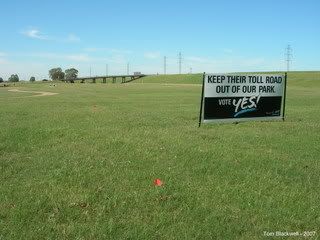
Flags mark the route of the proposed toll road in Trinity Park, Dallas. Voters will decide whether they want the toll road through the park.
A YES VOTE means that NO TOLL ROAD IS WANTED IN THE PARK.
A NO VOTE means that you WANT THE TOLL ROAD THROUGH THE PARK.
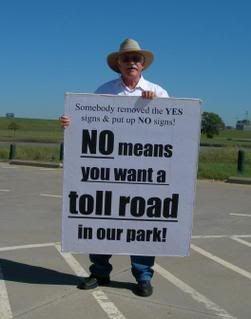
Below is a picture of the park where the proposed Trinity Toll Road is planned. Opponents (urging voters to vote YES) say too much land will be taken out of the park. The Toll Road will be high speed, without access to the park.

Photos used by permission of Tom Blackwell
Flags mark the route of the proposed toll road in Trinity Park, Dallas. Voters will decide whether they want the toll road through the park.
A YES VOTE means that NO TOLL ROAD IS WANTED IN THE PARK.
A NO VOTE means that you WANT THE TOLL ROAD THROUGH THE PARK.
Below is a picture of the park where the proposed Trinity Toll Road is planned. Opponents (urging voters to vote YES) say too much land will be taken out of the park. The Toll Road will be high speed, without access to the park.
How Represenatives from NCTCOG Region rank on the Environment - 2007 Texas Legislature
By Faith Chatham - DFWRCC - Oct. 20, 2007
Snapshot from Texas League of Conservation Voters Scorecard for 2007 Texas Legislature
A look at the scores Average House score: 56%
NOTE: BOLD FACE NAMES INDICATE ALL OR PART OF DISTRICT IS IN THE 16 COUNTY DFW REGION (NCTCOG)
At the top:
Burnam, Lon (D) 100% A+
Coleman, Garnet F. (D) 100% A+
Dunnam, Jim (D) 100% A+
Gallego, Pete (D) 100% A+
Howard, Donna (D) 100% A+
Miles, Borris (D) 100% A+
Naishtat, Elliott (D) 100% A+
Oliveira, Rene O. (D) 100% A+
Rodriguez, Eddie (D) 100% A+
Thompson, Senfronia (D) 100% A+
Bolton, Valinda (D) 96% A+
Davis, Yvonne (D) 96%
Escobar, Juan Manuel (D) 96% A+
Farias, Joe (D) 96% A+
Escobar, Juan Manuel (D) 96% A+
Herrero, Abel (D) 96% A+
Hochberg, Scott (D) 96% A+
Hodge, Terri (D) 96% A+
Leibowitz, David McQuade (D) 96% A+
Martinez, Armando (D) 96% A+
Noriega, Richard "Rick" (D) 96% A+
Olivo, Dora (D) 96% A+
Vaught, Allen (D) 96% A+
Veasey, Marc (D) 96% A+
Vo, Hubert (D) 96% A+
Pierson, Paula (D) 95% A+
Allen, Alma (D) 93% A+
Anchia, Rafael (D) 93%
Ortiz Jr., Solomon (D) 93% A+
Strama, Mark (D) 93% A+
Castro, Joaquin (D) 92% A+
Hernandez, Ana (D) 92% A+
Lucio III, Eddie (D) 92% A+
Martinez Fischer, Trey (D) 92% A+
Raymond, Richard (D) 92% A+
Chavez, Norma (D) 91% A+
Gonzalez Toureilles, Yvonne (D) 89% A
Alonzo, Roberto (D) 88% A
Garcia III, Juan (D) 88% A
Mallory Caraway, Barbara (D) 88% A
Moreno, Paul (D) 88% A
Cohen, Ellen (D) 88% A
Farrar, Jessica (D) 87% A
Villarreal, Michael (D) 86% A
Dukes, Dawnna (D) 85% A
Flores, Ismael "Kino" (D) 82% A
McClendon, Ruth (D) 80% A
Quintanilla, Chente (D) 80% A
Giddings, Helen (D) 79% B
Eiland, Craig (D) 78% B
Dutton Jr., Harold V. (D) 77% B
Menendez, Jose (D) 77% B
Frost, Stephen (D) 72% B
England, Kirk (R -switched to D) 69% B
McReynolds, Jim (D) 69% B
Puente, Robert (D) 68% B
Here are NCTCOG (DFW REGIONAL) Incumbents scores which are lower than B:
Hill, Fred (R) 44% D
Mowery, Anna (R) 37% D
Keffer, Jim (R) 35% D
Laubenberg, Jodie Anne (R) 35% D
King, Phil (R) 32% F
Geren, Charlie (R) 31% F
McCall, Brian (R) 31% F
Miller, Sid (R) 31% F
Paxton, Ken (R) 31% F
Patrick, Diane (R) 30% F
Goolsby, Tony (R) 30% F
Harper-Brown, Linda (R) 30% F
Jackson, Jim (R) 30% F
Solomons, Burt R. (R) 29% F
Hancock, Kelly G. 28% F
Zedler, Bill (R) 27% F
Orr, Rob (R) 26% F
Madden, Jerry (R) 27% F
Brown, Fred (R) 26% F
Smith, Todd (R) 26% F
Truitt, Vicki (R) 23% F
Crownover, Myra (R) 23% F
Branch, Dan (R) 22% F
Pitts, Jim (R) 22% F
Hartnett, Will (R) 21% F
See the Scorecard and examine the votes by issues ranked to determine the scores.
Look at previous session's scores.
When examining votes on toll road, there was less difference by party than was reflected by donors. The votes on the environment do reflect distinct party differences. This is sad. Republican voters also need clean air. Republican voters also have to breathe dirty air and children of Republican voters suffer from asthma and allergies at the same rate as children of Democratic voters. We do not know how distinct a difference will be shown when campaign donor bases are examined on a per vote basis by Legislator.
Snapshot from Texas League of Conservation Voters Scorecard for 2007 Texas Legislature
A look at the scores Average House score: 56%
Avg. Republican score: 32% FNow that Kirk England has switched parties, that means the highest scoring Republican got less than 69%.
Avg. Democratic score: 84% A
Perfect 100s: 11
Overachievers (A+): 36
Failures (F): 56
House Republicans over 50%: 2
House Democrats below 50%: 3
Highest Republican score: Kirk England (69%)
Lowest Democratic score: Joe Pickett (37%)
NOTE: BOLD FACE NAMES INDICATE ALL OR PART OF DISTRICT IS IN THE 16 COUNTY DFW REGION (NCTCOG)
At the top:
Burnam, Lon (D) 100% A+
Coleman, Garnet F. (D) 100% A+
Dunnam, Jim (D) 100% A+
Gallego, Pete (D) 100% A+
Howard, Donna (D) 100% A+
Miles, Borris (D) 100% A+
Naishtat, Elliott (D) 100% A+
Oliveira, Rene O. (D) 100% A+
Rodriguez, Eddie (D) 100% A+
Thompson, Senfronia (D) 100% A+
Bolton, Valinda (D) 96% A+
Davis, Yvonne (D) 96%
Escobar, Juan Manuel (D) 96% A+
Farias, Joe (D) 96% A+
Escobar, Juan Manuel (D) 96% A+
Herrero, Abel (D) 96% A+
Hochberg, Scott (D) 96% A+
Hodge, Terri (D) 96% A+
Leibowitz, David McQuade (D) 96% A+
Martinez, Armando (D) 96% A+
Noriega, Richard "Rick" (D) 96% A+
Olivo, Dora (D) 96% A+
Vaught, Allen (D) 96% A+
Veasey, Marc (D) 96% A+
Vo, Hubert (D) 96% A+
Pierson, Paula (D) 95% A+
Allen, Alma (D) 93% A+
Anchia, Rafael (D) 93%
Ortiz Jr., Solomon (D) 93% A+
Strama, Mark (D) 93% A+
Castro, Joaquin (D) 92% A+
Hernandez, Ana (D) 92% A+
Lucio III, Eddie (D) 92% A+
Martinez Fischer, Trey (D) 92% A+
Raymond, Richard (D) 92% A+
Chavez, Norma (D) 91% A+
Gonzalez Toureilles, Yvonne (D) 89% A
Alonzo, Roberto (D) 88% A
Garcia III, Juan (D) 88% A
Mallory Caraway, Barbara (D) 88% A
Moreno, Paul (D) 88% A
Cohen, Ellen (D) 88% A
Farrar, Jessica (D) 87% A
Villarreal, Michael (D) 86% A
Dukes, Dawnna (D) 85% A
Flores, Ismael "Kino" (D) 82% A
McClendon, Ruth (D) 80% A
Quintanilla, Chente (D) 80% A
Giddings, Helen (D) 79% B
Eiland, Craig (D) 78% B
Dutton Jr., Harold V. (D) 77% B
Menendez, Jose (D) 77% B
Frost, Stephen (D) 72% B
England, Kirk (R -switched to D) 69% B
McReynolds, Jim (D) 69% B
Puente, Robert (D) 68% B
Here are NCTCOG (DFW REGIONAL) Incumbents scores which are lower than B:
Hill, Fred (R) 44% D
Mowery, Anna (R) 37% D
Keffer, Jim (R) 35% D
Laubenberg, Jodie Anne (R) 35% D
King, Phil (R) 32% F
Geren, Charlie (R) 31% F
McCall, Brian (R) 31% F
Miller, Sid (R) 31% F
Paxton, Ken (R) 31% F
Patrick, Diane (R) 30% F
Goolsby, Tony (R) 30% F
Harper-Brown, Linda (R) 30% F
Jackson, Jim (R) 30% F
Solomons, Burt R. (R) 29% F
Hancock, Kelly G. 28% F
Zedler, Bill (R) 27% F
Orr, Rob (R) 26% F
Madden, Jerry (R) 27% F
Brown, Fred (R) 26% F
Smith, Todd (R) 26% F
Truitt, Vicki (R) 23% F
Crownover, Myra (R) 23% F
Branch, Dan (R) 22% F
Pitts, Jim (R) 22% F
Hartnett, Will (R) 21% F
See the Scorecard and examine the votes by issues ranked to determine the scores.
Look at previous session's scores.
When examining votes on toll road, there was less difference by party than was reflected by donors. The votes on the environment do reflect distinct party differences. This is sad. Republican voters also need clean air. Republican voters also have to breathe dirty air and children of Republican voters suffer from asthma and allergies at the same rate as children of Democratic voters. We do not know how distinct a difference will be shown when campaign donor bases are examined on a per vote basis by Legislator.
Friday, October 19, 2007
Transportation authority agrees to take bids from drilling firms
By GORDON DICKSON - Star-Telegram staff writer - Fri., Oct. 19, 2007
FORT WORTH -- The Fort Worth Transportation Authority agreed Thursday to seek bids from companies that want to drill for natural gas on or near T property, including bus and rail parking lots, the East Fort Worth transfer center and the T headquarters on East Lancaster Avenue.
Trinity Railway Express drilling rights were leased in 2006. Several companies have since approached the T about permission to drill nearby.In other action, the T board:
Agreed to a new contract with Yellow Checker Shuttle to run the Airporter bus service from downtown Fort Worth to Dallas/Fort Worth Airport for up to five more years. The company has operated the service since 2002.
Yellow Checker will operate under a one-year contract, with four one-year renewal options. The company will pay the T $1,200 a year for use of the Airporter Park & Ride lot at 1000 Weatherford St.
Also, Super Shuttle will continue to run the Route 30 circulator bus service from the Trinity Railway Express' Centreport/DFW Airport Station to area employers.
That agreement also is a one-year contract with four one-year options. Super Shuttle has performed that service since '02.
Welcomed two new board members: Gary Cumbie, special assistant to the Tarrant County College chancellor, was appointed to the T board by Fort Worth Councilman Danny Scarth and replaces Paul Geisel; Rosa Navejar, president of the Fort Worth Hispanic Chamber of Commerce, was appointed by Fort Worth Councilman Sal Espino and replaces Ed Canas.
Agreed to help Burleson, Cleburne, Crowley and Joshua conduct a rail study.
Read more
Ken Allard: Give TxDOT red light before it goes too far
By Ken Allard - San Antonio Express-News - 10/17/2007
Forgive me, fellow Texans, but I'm just a newcomer who looks ridiculous in a cowboy hat and doesn't even own an SUV. Quickly recognizing Eastern transplants, tourist shops try to sell me bumper stickers: "Wasn't born in Texas, but I got here just as soon as I could."So can you help me connect these dots while we wait for the daily Boerne-Loop 410-airport-Seguin-San Marcos traffic jam to clear up?
News item No. 1: Pleading a funding shortage, the Texas Department of Transportation announced it will cut $1.8 billion in road construction, including at least $57 million (apparently earmarked in a weak moment) to widen clogged San Antonio highways.
News item No. 2: Today, Travis County District Judge Orlinda Naranjo will decide if TxDOT officials acted illegally in spending taxpayer funds to drum up political support for toll roads (TxDOT's preferred solution to the state's transportation crisis).
News item No. 3: A private contractor received more than $750,000 from TxDOT to send road condition surveys to 150,000 presumably startled motorists whose license plates were "randomly recorded" by TxDOT surveillance cameras hidden in orange barrels on Interstate 35 from Laredo to Dallas.
As a one-time regular on his MSNBC simulcast, I would often hear radio shock jock Don Imus exclaim, "You just can't make this stuff up!" Indeed you can't when it comes to TxDOT, which gives an entirely new meaning to the phrase "out of control."
Has no one in the Lone Star State ever heard of "checks and balances"? (Hint to local high schoolers about to endure new rounds of standardized testing: This term does not refer to financial matters!)
Had TxDOT somehow been cast as a character on "The Sopranos," the only question would be: How long before Paulie Walnuts takes 'em out to get whacked?
While the arrogance of government agencies and personalities is the hardiest of all perennials, there is always the inevitable downside.
A powerful congressman such as Wilbur Mills winds up cavorting with stripper Fanne Fox in the Tidal Basin. FBI Director J. Edgar Hoover is eventually revealed to have had a fondness for basic black, apparently accessorized with really nice pumps and pearls.
So just how far can TxDOT push its luck before somebody wakes up and gives the agency its long overdue comeuppance?
Had anything like the trifecta of excesses outlined above occurred in Washington rather than Austin, the offending agency director would have been instantly summoned to appear before investigating committees, with the usual tiers of media mavens and photographers-in-waiting. With cameras scrutinizing every flinch, the tough questions for the TxDOT director would begin.
Who decides which road improvements are funded by your agency — and with whose concurrence? What public input is solicited, and why should the public believe TxDOT when you say you're running out of money?
What gives you the idea that a taxpayer-funded public agency has any business using those tax dollars to lobby for its own interests? And why waste almost a million dollars on a "Big Brother" survey about road conditions that your department should have understood to begin with?
Until such questions are asked and answered, simply think of TxDOT as a state agency being gradually auctioned off to a hot-bidding coalition of builders, developers, heavy equipment contractors and construction magnates.
One thing is certain: We are quickly losing much of San Antonio's special character to chaos — unbridled expansion, high-density housing and utterly unplanned growth. Despite growing questions about its transparency and competence, TxDOT acts as an obliging accomplice while fields, forests and the last remnants of an irreplaceable frontier culture are bulldozed into 24 lanes of privatized, toll-bearing concrete, complete with access roads.
Know what San Antonio will look like if these guys win? Houston!
Know what we are if we let that happen? Stupid!
Reasons enough to demand that our political leaders bring TxDOT's antics to a screeching halt before it starts putting up toll booths at the end of your driveway.
(Got here just as soon as I could to warn you.)
Highway 121 project receives federal environmental clearance
By MICHAEL A. LINDENBERGER - The Dallas Morning News - Thursday, October 18, 2007
The federal government issued an environmental clearance Wednesday for the controversial -- and much delayed -- State Highway 121 toll road project. That clearance was required before the Texas Department of Transportation could sign the project agreement already negotiated and agreed to by the North Texas Tollway Authority.
Mark Ball, a spokesman for TxDOT's Dallas district, said it was not immediately clear how soon the department's executive director would sign the project agreement.
NTTA, which has promised to pay $3.3 billion for the road contract, has already signed the agreement and has been waiting for weeks for TxDOT's signature. The latter was delayed, however, until final federal environmental clearance was achieved.
Faced with the delay by the Federal Highway Administration, the Texas Transportation Commission voted Aug. 23 to cancel a deadline that had initially stipulated that if NTTA could not sign an agreement by Aug. 29, the deal would revert to Spanish builder Cintra.
Now that the federal clearance has been issued, TxDOT is expected to sign the agreement. Once it does, NTTA will have 45 days to close its financing and make the upfront payments. The payments are in return for the right to build the 26-mile toll road in Collin and Denton counties and collect tolls for the next 50 years.
Already, local governments in North Texas have proposed hundreds of transportation projects that would be paid for by the money NTTA has promised to pay.
The initial $3.3 billion figure may be adjusted somewhat, thanks to the variations in the bond market that have taken place because of the mortgage market crisis, regional transportation and NTTA officials have said.
Read more in the Dallas Morning News
Highway 121 money split - Denton, Collin get most of $3 billion; some in Collin upset
By THEODORE KIM - The Dallas Morning News - Friday, October 12, 2007
ARLINGTON – After years of arm-twisting over the sale of the State Highway 121 toll road, the payoff is finally here.
And while nobody got exactly what they wanted, forgive Denton County for smiling a little more than its neighbor to the east.
On Thursday, the Regional Transportation Council approved the division of the roughly $3 billion payout from the sale of the toll road to surrounding counties.
The decision came despite the grumbling of leaders in Collin County, who said the divisions will shortchange their county out of millions.
At stake is billions of dollars that will be generated almost immediately under the state's deal to sell tolling rights on Highway 121.
Earlier this year, the North Texas Tollway Authority agreed to pay the state $2.5 billion up front and $833 million in additional revenue for the right to collect tolls on the road for the next 50 years.
The council, a 40-member panel of local officials that sets transportation policy, was tasked with dividing that payout among area counties.
Under the plan, the majority of the money was set aside for Denton County, which will receive $1.56 billion, and Collin County, which will get $1.18 billion. The proposal was based in large part on estimates of how many vehicles will use the highway in each county in the future.
Those amounts fall far short of the roughly $9 billion in total requests the counties had initially made to the council for road projects.
Moreover, the counties will actually receive somewhat less because, in part, the earmarks include the cost of finishing Highway 121, slated for completion by decade's end.
Because of that, some officials said they felt the agreement unfairly penalizes Collin County. Denton's segment of the road, funded largely by gasoline-tax revenue, is mostly complete. Collin's half is being built now and will be funded by its portion of the toll-road deal.
Of Collin's payout, about half – $600 million – will help the NTTA finish the project. By comparison, Denton will contribute about $41 million to the project from its payout.
"Why are the construction costs of [Highway] 121 being added to the county's share?" asked Plano City Council member Loretta Ellerbe, the only transportation council member who voted against the plan. "It makes no sense."Thursday's action is the latest development in the closely watched sale of Highway 121, which runs about 30 miles between Dallas/Fort Worth International Airport and U.S. Highway 75 near McKinney.
The project has come to symbolize the new and controversial way that communities nationwide are paying for roads and highways.
With gasoline-tax revenue unable to cover growing transportation needs, political leaders here and elsewhere have pioneered the practice of selling long-term tolling rights on roads in exchange for large upfront cash payments.
While others echoed Ms. Ellerbe's dissent, the transportation council said they generally supported the plan.
Member Cynthia White, a Denton County commissioner, encouraged her colleagues to set aside regional biases in favor of curtailing growing traffic across the area.
"All these [road] projects are interdependent," she said.
Another member, Collin County Commissioner Joe Jaynes, said he voted for the plan because in the end it will mean hundreds of millions for new roads.
"Nobody was completely satisfied," Mr. Jaynes said. "I think that's a sign of a good compromise."
Read more in the Dallas Morning News
Thursday, October 18, 2007
Turf prevails as Judge grants continuance, allows discovery - TURF attorneys may depose top TxDOT officials
By TERRI HALL - Texans Uniting for Reform & Freedom (TURF)- Oct. 18, 2007
Austin, TX – Thursday, October 18, 2007 - In Travis County District Court today, Judge Orlinda Naranjo granted Texans Uniting for Reform and Freedom (TURF) a continuance allowing TURF to force the Texas Department of Transportation (TxDOT) to move to the discovery phase and depose top TxDOT officials, including Transportation Commission Chairman Ric Williamson himself. Allowing discovery is vital for TURF to force TxDOT to hand over key documents that they’ve been withholding via Open Records requests. TURF is seeking to immediately halt the illegal advertising campaign and lobbying by TxDOT. LINK.
The State was attempting to throw us out of court with their favorite “get out of jail free” card (called the plea to the jurisdiction), but TURF’s attorneys, Charlie Riley, David Van Os, and Andrew Hawkins outmaneuvered Attorney General counsel Kristina Silcocks to file a motion for a continuance to allow TURF to move to the discovery phase to gather evidence to show TxDOT’s top brass broke the law with the Keep Texas Moving (KTM) ad campaign and lobbying Congress to buyback interstates.
“This is a great victory for Texas taxpayers!” an elated Terri Hall, TURF’s Founder and Executive Director proclaimed. “This egregious misuse of $9 million of taxpayer money by a rogue government agency is one MAJOR step closer to being stopped.”
The tide seemed to turn when Riley showed the affidavit by TxDOT’s Helen Havelka was false. TURF uncovered this August 13, 2007 memo by Coby Chase through an Open Records request showing the Keep Texas Moving campaign was not over and in fact it has multiple phases planned with the next one fashioned to influence the upcoming Trans Texas Corridor TTC-69 NEPA (National Environmental Policy Act) hearings planned for early 2008.
With a clear attempt to mislead the court by causing Judge Naranjo and the public to believe the KTM Campaign was over when in fact it isn’t, the State’s credibility and case went downhill from there.
“I wonder what TxDOT’s top brass is saying tonight as they’re being informed they’ve now been added as defendants and may be deposed under oath about their lobbying and ad campaign activities,” pondered Hall. “My guess is the phones are ringing and the paper shredders may just get fired-up.
This lawsuit is brought pursuant to § 37, Texas Civil Practice and Remedies Code. TxDOT’s expenditure of public funds for the Keep Texas Moving campaign is illegal, and an injunction prohibiting any further illegal expenditures in this regard.
TxDOT has violated § 556.004 of the Texas Government Code by directing the expenditure of public funds for political advocacy in support of toll roads and the Trans Texas Corridor, and have directly lobbied the United States Congress in favor of additional toll road programs as evidenced in its report, Forward Momentum.
On Monday, September 24, Judge Orlinda Naranjo did not initially grant a temporary restraining order (TRO). TxDOT unearthed a law that says they can advertise toll roads (Sec 228.004 of Transportation Code) and the citizens invoked another that says they can’t (Chapter 556, Texas Government Code). The burden to obtain a TRO is higher than for an injunction.
“TxDOT is waging a one-sided political ad campaign designed to sway public opinion in favor of the policy that puts money in TxDOT’s own coffers. School Boards cannot lobby in favor of their own bond elections, and yet TxDOT cites its own special law to line their own pockets at taxpayers’ expense,” says an incredulous Terri Hall, Founder/Director of TURF.
Hall also notes that TxDOT’s campaign goes beyond mere advertising, “It’s propaganda and in some cases, the ads blatantly lie to the public! In one radio ad it claims it’s not signing contracts with non-compete agreements in them, and yet last March TxDOT inked a deal with Cintra-Zachry for SH 130 that had a non-compete clause (which either prohibits or financially punishes the State for building competing infrastructure with a toll road). Read about it here.”On this link scroll down to radio ad “continuing maintenance”).
On August 22, 2007, TURF filed a formal complaint with Travis County District Attorney Ronnie Earle to investigate TxDOT’s illegal lobbying and asked him to prosecute TxDOT for criminal wrongdoing. See the formal complaint here . The petition seeks immediate injunctive relief in a civil proceeding.
Updates to TURF’s petition and supplemental affidavits will be posted soon.
Senate Committee on Transportation & Homeland Security Meeting Schedule Nov. 07-Nov. 08
Thursday, November 8, 2007 10:00 AM
Senate Committee on Transportation & Homeland Security
Location: Museum of Art, 1 Arts Festival Plaza,
El Paso, Texas
NO LIVE BROADCAST
Tuesday, February 8, 2008 8:00 AM
Senate Committee on Transportation & Homeland Security
Location: Capitol Extension, Room E1.016
YES LIVE BROADCAST
Tuesday, May 20, 2008 8:00 AM
Senate Committee on Transportation & Homeland Security
Location: Capitol Extension, Room E1.016
YES LIVE BROADCAST
Tuesday, August 5, 2008 8:00 AM
Senate Committee on Transportation & Homeland Security
Location: Westin Hotel, DFW Airport, 4545 W. John Carpenter Fwy. Irving, Texas
NO LIVE BROADCAST
Tuesday, November 18, 2008 8:00 AM
Senate Committee on Transportation & Homeland Security
Location: Capitol Extension, Room E1.016
YES LIVE BROADCAST
LINK: http://www.senate.state.tx.us/75r/Senate/commit/c640/c640.htm
Events LINK: http://www.senate.state.tx.us/75r/Senate/Events.htm
Receive Notification on Schedule Postings
LINK: http://www.legis.state.tx.us/MyTLO/Alerts/Posting.aspx?Type=Notices
For those who want to receive weekly e-mail notification regarding all posted senate committee schedule notices
Senate Committee on Transportation & Homeland Security
Location: Museum of Art, 1 Arts Festival Plaza,
El Paso, Texas
NO LIVE BROADCAST
Tuesday, February 8, 2008 8:00 AM
Senate Committee on Transportation & Homeland Security
Location: Capitol Extension, Room E1.016
YES LIVE BROADCAST
Tuesday, May 20, 2008 8:00 AM
Senate Committee on Transportation & Homeland Security
Location: Capitol Extension, Room E1.016
YES LIVE BROADCAST
Tuesday, August 5, 2008 8:00 AM
Senate Committee on Transportation & Homeland Security
Location: Westin Hotel, DFW Airport, 4545 W. John Carpenter Fwy. Irving, Texas
NO LIVE BROADCAST
Tuesday, November 18, 2008 8:00 AM
Senate Committee on Transportation & Homeland Security
Location: Capitol Extension, Room E1.016
YES LIVE BROADCAST
LINK: http://www.senate.state.tx.us/75r/Senate/commit/c640/c640.htm
Events LINK: http://www.senate.state.tx.us/75r/Senate/Events.htm
Receive Notification on Schedule Postings
LINK: http://www.legis.state.tx.us/MyTLO/Alerts/Posting.aspx?Type=Notices
For those who want to receive weekly e-mail notification regarding all posted senate committee schedule notices
TxDOT coached on thwarting toll foes on talk radio
Peggy Fikac - Express- News Austin bureau AUSTIN — 10/17/2007
When Texas transportation officials talk about bridges these days, they don't necessarily mean steel spans and concrete girders. Instead, they are being taught how to "bridge" from off-message questions to their own talking points in a toll-road campaign.
"You will often be asked questions that don't get to the points you wish to make or that you don't wish to answer," says a "radio interview techniques" section of Texas Department of Transportation documents released under the Public Information Act. "You can use bridging to turn the question to your points."
One useful phrase, suggests the document — prepared by consultants who are to be paid $24,500 for talk-radio training for the campaign, and tweaked by the department — is this: "I think what you are really asking is ..."
The document also offers this timeless advice: "Keep calm. Leave wrestling to the pigs. They always end up looking like pigs."
The training document is part of the multimillion-dollar Keep Texas Moving campaign, the subject of a court hearing today.
The hearing comes after activist Terri Hall of the San Antonio Toll Party and Texans Uniting for Reform and Freedom filed a court petition to stop the agency from spending public funds on the campaign, projected to cost $7 million to $9 million in highway money.
Hall also wants to block any lobbying attempts by transportation officials to persuade Congress to allow more toll roads.
The Keep Texas Moving campaign has a focus on toll roads and the Trans-Texas Corridor network. Both are touted by GOP Gov. Rick Perry and others as necessary in the face of congestion and gas-tax revenues that fall short of meeting road needs. Criticism has centered on the potential corridor route and on the state partnering with private firms to run toll roads.
In her court filing, Hall contends that transportation officials, in promoting the initiatives, are violating a ban on lobbying and on using their authority for political purposes.
The state says TxDOT is allowed by law to promote toll projects and that its campaign is a response to a call from the public and from elected officials for more information on road initiatives.
State District Judge Orlinda Naranjo of Travis County last month refused to order an immediate stop to the spending. Naranjo today will consider a state request that she dismiss the case.
The state contends the legal complaint is moot because an existing contract for media services was due to end Sept. 30.
Thompson Marketing of San Antonio got a state contract of nearly $2 million last year for the first phase of the project, which included a marketing development plan and such items as TV and radio spots, print ads, internet banner ads and billboards.
The company billed the agency in March regarding a Senate transportation hearing and in April and May for "legislature, media monitoring for strategic planning, messaging." Lawmakers this year worked to curb new private toll projects.
The state plans no more spending on "any future media placement under the current Keep Texas Moving campaign" but still needs to pay Thompson Marketing for some previous work, said an affidavit by Helen Havelka, the campaign's manager.
The agency also has a $20,000 contract for talk-radio training for transportation officials with the Rodman Co., which subcontracted with ViaNovo, whose team includes former Bush strategist Matthew Dowd. It plans another $4,500 training class, and the two consulting companies plan two telephone town-hall meetings at a cost of $17,480.
Rodman and ViaNovo worked on the radio training guide, said TxDOT spokesman Chris Lippincott, who also had input on the document, titled "Talking on Talk Radio."
"The talk radio environment runs the gamut from productive and thoughtful to vitriolic and silly," Lippincott said. "We certainly want to prepare (agency spokespeople) for all possibilities, and that includes everyone from a skeptical talk-show host to an outright hostile caller."
Read more in the San Antonio Express News
Wednesday, October 17, 2007
Subscribe to:
Posts (Atom)

